
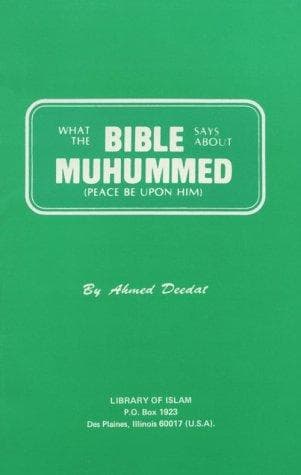
What the Bible Says About Muhammad
ما يقوله الكتاب المقدس عن محمد
Ce que Dit la Bible sur Mahomet
Editorial summary
Ahmed Deedat's "What the Bible Says About Muhammad" represents a significant contribution to Islamic apologetics within the context of interfaith dialogue between Christianity and Islam. Published in 1976, this monograph advances the controversial claim that biblical texts contain prophecies specifically referring to the Prophet Muhammad, thereby legitimating Islam's status as a divinely revealed religion continuous with the Judeo-Christian tradition.
Deedat's central argument rests on a detailed exegetical analysis of several biblical passages, most notably Deuteronomy 18:18 and various references in the Gospel of John to the "Paraclete" or "Comforter." He contends that these texts, when properly interpreted, point not to Jesus Christ or the Holy Spirit as Christian tradition maintains, but to Muhammad as the final prophet in the Abrahamic lineage. His methodology combines textual criticism with comparative religious analysis, drawing on both original Hebrew and Greek terms while also incorporating Islamic theological perspectives.
The work emerges from and contributes to a long tradition of Islamic polemic literature that seeks to establish Muhammad's prophetic legitimacy through Jewish and Christian scriptures. Deedat positions his argument against mainstream Christian biblical interpretation, challenging what he perceives as deliberate misreadings or mistranslations that obscure references to Muhammad. His approach reflects the broader Muslim theological principle that earlier scriptures, though corrupted over time, retain traces of authentic divine revelation that point toward Islam.
Deedat's significance lies not merely in his specific arguments but in his role as a prominent figure in 20th-century Islamic da'wah (missionary activity). His work exemplifies a particular mode of religious argumentation that seeks to validate Islamic claims through the very texts that Christians hold sacred. This approach simultaneously affirms the divine origin of biblical revelation while asserting its supersession by the Quran.
The monograph's impact extends beyond academic circles into popular religious discourse, influencing how many Muslims understand the relationship between Islam and earlier Abrahamic faiths. While Christian scholars generally reject Deedat's interpretations as eisegetical, his work remains influential in Muslim apologetics and continues to shape contemporary interfaith debates about scriptural authority, prophetic succession, and the nature of divine revelation across religious traditions.
Argument formulations engaged
Deedat, Ahmed (1976). What the Bible Says About Muhammad.
@book{what-the-bible-says-about-muhammad-1976,
  author    = {Deedat, Ahmed},
  title     = {What the Bible Says About Muhammad},
  year      = {1976},
  url       = {https://god-database.com/en/works/what-the-bible-says-about-muhammad-1976}
}