
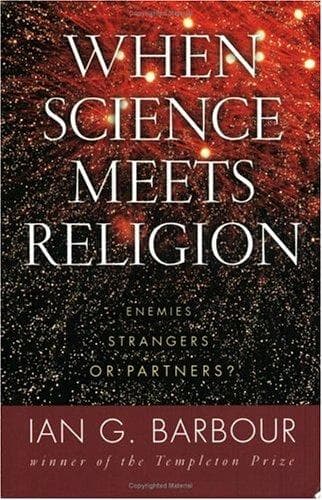
When Science Meets Religion.. Enemies, Strangers, or Partners
حين يلتقي العلم بالدين.. أعداء أم غرباء أم شركاء
Quand la science rencontre la religion.. Ennemis, étrangers ou partenaires
The relationship between science and religion is best understood not as inevitable conflict or mutual indifference but as a spectrum of possible interactions, with genuine dialogue and integration as the most intellectually fruitful options.
Editorial summary
Ian Barbour's "When Science Meets Religion: Enemies, Strangers, or Partners?" (2000) presents a systematic typology for understanding the diverse ways science and religion have interacted throughout history and continue to relate in contemporary discourse. Drawing on his extensive background in both physics and theology, Barbour develops a fourfold classification scheme that has become influential in philosophy of science and religious studies.
The work identifies four primary models of science-religion interaction: conflict, independence, dialogue, and integration. The conflict model, exemplified by scientific materialism and biblical literalism, assumes these domains are fundamentally incompatible. The independence model, associated with neo-orthodoxy and existentialism, maintains that science and religion operate in separate spheres with distinct languages and methods. The dialogue model seeks constructive engagement through boundary questions and methodological parallels, while the integration model attempts synthesis through natural theology, theology of nature, or process thought.
Barbour applies this typology across major scientific domains including astronomy, quantum physics, evolution, neuroscience, and genetics. Rather than advocating a single approach, he demonstrates how different models may be appropriate for different issues. His analysis reveals that the popular "warfare" narrative between science and religion represents only one possible relationship among many. The work critiques reductionist approaches from both scientific materialists who dismiss religious experience and religious fundamentalists who reject scientific findings.
The monograph's philosophical significance lies in its nuanced treatment of epistemological and metaphysical questions arising at the science-religion interface. Barbour examines how each model handles issues of causation, purpose, and the nature of reality. His discussion of critical realism as a shared epistemological framework between scientific and religious inquiry has proven particularly influential. The work engages with major figures including Stephen Jay Gould's "non-overlapping magisteria," Arthur Peacocke's theological naturalism, and various process theologians.
While Barbour's personal preference for the integration model, particularly process thought, becomes apparent, the work's primary contribution remains its descriptive taxonomy rather than prescriptive advocacy. This typology has provided scholars and educators with conceptual tools for analyzing science-religion discussions beyond simplistic conflict narratives. The monograph's balanced treatment and comprehensive scope have made it a standard reference in courses on science and religion, demonstrating that multiple legitimate perspectives exist on this enduring philosophical question.
Structured analysis
Argument formulations engaged
Related works
Barbour, Ian G. (2000). When Science Meets Religion.. Enemies, Strangers, or Partners. HarperOne.
@book{when-science-meets-religion-enemies-stra,
  author    = {Barbour, Ian G.},
  title     = {When Science Meets Religion.. Enemies, Strangers, or Partners},
  year      = {2000},
  publisher = {HarperOne},
  url       = {https://god-database.com/en/works/when-science-meets-religion-enemies-strangers-or-partners}
}