
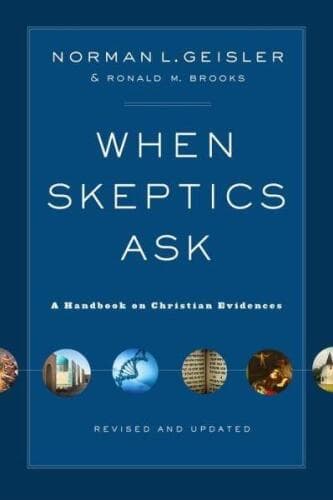
When Skeptics Ask: A Handbook on Christian Evidences
عندما يسأل المشككون: دليل الأدلة المسيحية
Quand les Sceptiques Questionnent : Un Manuel sur les Preuves Chrétiennes
Editorial summary
This comprehensive apologetic handbook systematically addresses skeptical challenges to Christian theism through philosophical argumentation and evidential analysis. Geisler constructs a cumulative case for Christian belief by examining fundamental questions about reality, knowledge, God, miracles, Jesus Christ, and biblical authority. The work represents a significant contribution to late twentieth-century evangelical apologetics, synthesizing classical theistic arguments with contemporary evidentialist approaches.
The text begins with foundational epistemological considerations, establishing criteria for truth and examining the relationship between faith and reason. Geisler argues that Christianity provides coherent answers to ultimate questions about existence, meaning, and morality that skeptical worldviews cannot adequately address. He employs classical theistic arguments—cosmological, teleological, and moral—while updating them to engage modern scientific and philosophical objections. The treatment of the cosmological argument particularly incorporates contemporary astrophysics, including big bang cosmology, to support the case for divine creation.
Central to Geisler's methodology is his defense of the possibility and identifiability of miracles against Humean skepticism. He contends that philosophical naturalism begs the question against supernatural intervention and that historical investigation can establish miraculous events when properly understood. This framework undergirds his subsequent examination of the resurrection of Jesus, which he presents as the best explanation for the historical data concerning the empty tomb, post-mortem appearances, and the origin of Christian belief.
The work addresses biblical reliability through analysis of manuscript evidence, archaeological corroboration, and fulfilled prophecy. Geisler responds to higher critical challenges while maintaining conservative positions on authorship, dating, and historical accuracy. He dedicates substantial attention to the problem of evil, offering a free will defense combined with arguments from the greater good and the limitations of human perspective.
Throughout, Geisler engages skeptical philosophers from Hume to Russell, contemporary critics like Antony Flew and Michael Martin, and addresses popular-level objections. His approach combines rigorous philosophical analysis with accessibility, making complex arguments comprehensible to educated lay readers. The handbook's systematic organization and comprehensive scope established it as a standard reference work in evangelical apologetics, influencing subsequent defenders of Christian theism. While critics challenge his philosophical assumptions and historical conclusions, the work remains significant for its thorough articulation of late twentieth-century evangelical responses to skepticism.
Argument formulations engaged
Geisler, Norman (1990). When Skeptics Ask: A Handbook on Christian Evidences. Baker Books.
@book{when-skeptics-ask-a-handbook-on-christia,
  author    = {Geisler, Norman},
  title     = {When Skeptics Ask: A Handbook on Christian Evidences},
  year      = {1990},
  publisher = {Baker Books},
  url       = {https://god-database.com/en/works/when-skeptics-ask-a-handbook-on-christian-evidences-1990}
}