
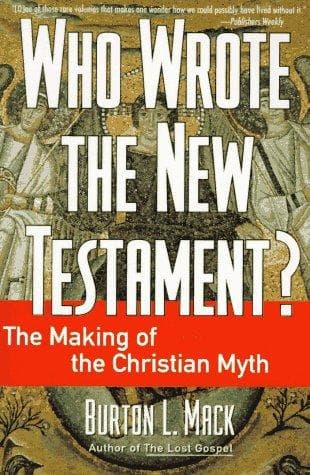
Who Wrote the New Testament?
من كتب العهد الجديد؟
Qui a Écrit le Nouveau Testament ?
Editorial summary
Burton Mack's "Who Wrote the New Testament?" presents a comprehensive historical-critical analysis of early Christianity's formation, challenging traditional accounts of Christian origins and their theological implications. The work employs social-historical methodology to reconstruct the diverse communities and movements that produced the New Testament texts, arguing that Christianity emerged not from a singular divine revelation but through complex social processes of myth-making and community formation.
Mack's central thesis posits that the New Testament represents multiple, often conflicting attempts by various groups to construct meaningful narratives about Jesus and establish distinct social identities. He traces how different communities—from the Q people to Pauline congregations—developed divergent traditions that were later harmonized into an artificial unity. This reconstruction directly challenges supernatural explanations of Christian origins, suggesting instead that theological claims about Jesus's divinity emerged through gradual mythologization rather than historical witness.
The work systematically deconstructs the gospel narratives, analyzing them as literary creations serving specific social functions rather than historical records. Mack argues that Mark invented the narrative gospel form, creating a foundation myth that subsequent writers elaborated. He demonstrates how each gospel reflects its community's particular concerns and conflicts, undermining claims of divine inspiration or eyewitness testimony. His analysis of Paul reveals not a convert to an established religion but an innovator creating new religious meanings through creative interpretation of Jewish traditions and Hellenistic philosophy.
Mack's contribution to debates about God lies in his naturalistic explanation of Christianity's emergence. By showing how religious movements develop through ordinary social processes, he implicitly argues against divine intervention in history. His work provides ammunition for those who view religions as human constructions rather than revealed truths. The detailed analysis of myth-making processes suggests that concepts of God evolve through human creativity responding to social needs.
The monograph's significance extends beyond biblical studies to broader questions about religious epistemology. If Christianity's foundational texts emerged through the processes Mack describes, similar dynamics likely shaped other religious traditions. His work thus contributes to understanding religion as a human phenomenon susceptible to historical and sociological analysis rather than requiring theological explanation. While Mack avoids explicit philosophical conclusions about God's existence, his thoroughgoing naturalism and reduction of religious claims to social functions align with secular approaches to religious studies.
Argument formulations engaged
Related works
Mack, Burton (1995). Who Wrote the New Testament?.
@book{who-wrote-the-new-testament-1995,
  author    = {Mack, Burton},
  title     = {Who Wrote the New Testament?},
  year      = {1995},
  url       = {https://god-database.com/en/works/who-wrote-the-new-testament-1995}
}