
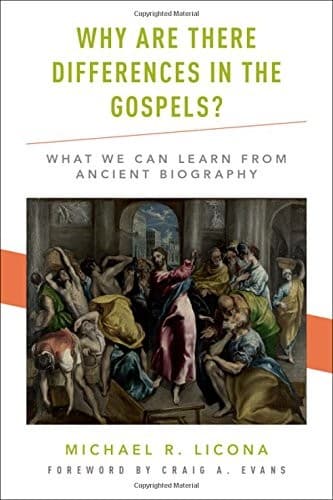
Why Are There Differences in the Gospels?
لماذا توجد اختلافات في الأناجيل؟
Pourquoi Y a-t-il des Différences dans les Évangiles ?
Editorial summary
Michael Licona's "Why Are There Differences in the Gospels?" examines apparent contradictions and discrepancies between the four canonical Gospel accounts through the lens of ancient Greco-Roman biographical conventions. The work responds to longstanding challenges posed by skeptics and critical scholars who argue that Gospel differences undermine their historical reliability and, by extension, the credibility of Christian claims about divine revelation.
Licona's central thesis contends that the Gospel writers employed compositional devices standard in ancient biography, including compression, transferal, displacement, conflation, and literary spotlighting. Drawing on extensive analysis of Plutarch's parallel lives, where the same events appear with variations across different biographies, Licona demonstrates that such techniques represented accepted historiographical practice rather than errors or fabrications. He systematically examines nineteen pericopes appearing in multiple Gospels, categorizing the types of differences and proposing explanations rooted in ancient literary conventions.
The work engages primarily with two scholarly camps: skeptical critics who view Gospel differences as evidence against divine inspiration, and conservative evangelicals who attempt to harmonize all accounts into seamless consistency. Licona challenges the former by showing that variations need not indicate historical unreliability when understood within their proper generic context. He critiques the latter by arguing that modern expectations of precision impose anachronistic standards on ancient texts, potentially missing how the Gospel writers actually understood and practiced historical narrative.
Methodologically, Licona combines classical philological analysis with contemporary historiographical theory. His approach reflects the influence of scholars like Richard Burridge on Gospel genre and Craig Keener on ancient biography, while engaging with critics like Bart Ehrman who emphasize Gospel contradictions as problematic for traditional Christian faith.
The monograph's significance for the God debate lies in its sophisticated defense of Gospel reliability without resorting to forced harmonization. By demonstrating that the Gospel writers operated within recognized ancient literary conventions, Licona provides a framework for maintaining both the historical grounding of Christian claims and the theological doctrine of biblical inspiration. His work suggests that God's revelation through Scripture accommodates human literary practices rather than overriding them. This nuanced position offers theists a scholarly response to skeptical challenges while acknowledging the genuine phenomena of Gospel differences that any serious historical approach must address.
Argument formulations engaged
Related works
Licona, Michael (2017). Why Are There Differences in the Gospels?. Oxford University Press.
@book{why-are-there-differences-in-the-gospels,
  author    = {Licona, Michael},
  title     = {Why Are There Differences in the Gospels?},
  year      = {2017},
  publisher = {Oxford University Press},
  url       = {https://god-database.com/en/works/why-are-there-differences-in-the-gospels-2017}
}