
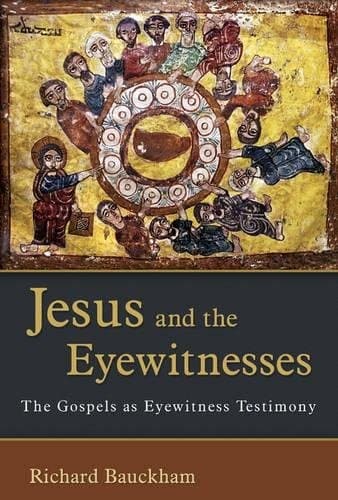
Jesus and the Eyewitnesses
يسوع وشهود العيان
Jésus et les témoins oculaires
The Gospels are best understood as eyewitness testimony, with named individuals in the narratives serving as identifiable sources whose personal recollections underlie the written accounts.
Editorial summary
Richard Bauckham's Jesus and the Eyewitnesses presents a comprehensive historical argument for the reliability of the Gospel accounts based on eyewitness testimony. The work challenges the dominant form-critical consensus that emerged in twentieth-century New Testament scholarship, which viewed the Gospels as products of anonymous community traditions that evolved through multiple stages of oral transmission. Against this paradigm, Bauckham argues that the Gospels preserve direct eyewitness testimony from those who knew Jesus personally, transmitted through controlled processes that maintained substantial historical accuracy.
The monograph employs rigorous historical-critical methodology to examine ancient historiographical practices, memory studies, and the internal evidence of the Gospel texts themselves. Bauckham demonstrates that the Gospels exhibit features consistent with eyewitness accounts, including the prominence of named individuals who served as authoritative sources, the presence of vivid and seemingly incidental details, and patterns of perspective that suggest firsthand observation. He pays particular attention to the role of the Twelve Apostles as an official body of eyewitnesses and explores how individual testimonies, particularly that of Peter behind Mark's Gospel and the "Beloved Disciple" behind John's Gospel, shaped the Gospel traditions.
Central to Bauckham's argument is his analysis of personal names in the Gospels, which he shows correspond remarkably to the pattern of Jewish names in first-century Palestine as known from other sources. This correlation suggests authentic historical memory rather than later fictive creation. He also engages contemporary psychological research on memory, arguing that while human memory is not mechanically reproductive, it reliably preserves the substance of significant events, particularly those of unique importance like those surrounding Jesus.
The work's significance for the God debate lies in its potential to restore confidence in the Gospels as historically reliable sources for knowledge about Jesus of Nazareth. If the Gospels preserve authentic eyewitness testimony, then their accounts of Jesus's teachings about God, his claims to divine authority, and the disciples' experiences of his resurrection carry greater evidential weight. While Bauckham does not directly argue for theism, his historical conclusions provide crucial support for traditional Christian claims about divine revelation in history. The monograph thus strengthens the historical foundation upon which evidential arguments for Christian theism typically rest, making it a significant contribution to contemporary debates about religious knowledge and the rationality of belief in God.
Structured analysis
Argument formulations engaged
Related works
Bauckham, Richard Jesus and the Eyewitnesses.
@book{jesus-and-the-eyewitnesses,
  author    = {Bauckham, Richard},
  title     = {Jesus and the Eyewitnesses},
  year      = {n.d.},
  url       = {https://god-database.com/en/works/jesus-and-the-eyewitnesses}
}