
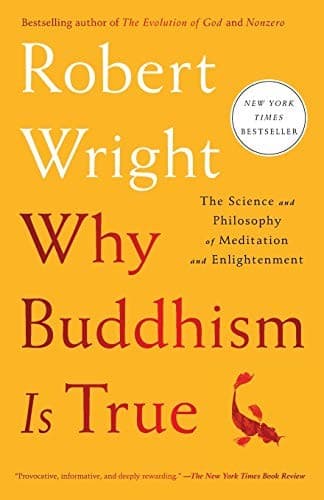
Why Buddhism is True
لماذا البوذية صحيحة
Pourquoi le Bouddhisme est Vrai
Editorial summary
Robert Wright's Why Buddhism is True presents a distinctive argument that Buddhist meditation and psychology align remarkably with findings from evolutionary psychology and cognitive science. Wright contends that natural selection has equipped humans with systematic delusions about the nature of self and reality, and that Buddhist contemplative practices offer empirically validated methods for seeing through these illusions. The work represents a significant contribution to naturalistic approaches to religious wisdom traditions.
Wright's central thesis holds that evolution has programmed humans with perceptual and emotional biases that once aided survival but now generate unnecessary suffering. He argues that Buddhist claims about the illusory nature of the self, the pervasiveness of suffering, and the possibility of liberation through mindfulness meditation find support in contemporary psychological research. Drawing on his own meditation experiences alongside scientific studies, Wright demonstrates how mindfulness practices can reveal the modular nature of mind, the constructedness of emotional responses, and the lack of a unified controlling self.
The work engages critically with both traditional Buddhist metaphysics and reductive scientific materialism. Wright explicitly brackets supernatural elements of Buddhism, including rebirth and karma, focusing instead on what he terms "naturalistic Buddhism." He positions his argument against both religious traditionalists who insist on accepting Buddhism's metaphysical commitments and scientific skeptics who dismiss contemplative insights as mere subjective states. His approach exemplifies a growing trend of extracting practical wisdom from religious traditions while rejecting their supernatural claims.
Wright's methodology combines first-person phenomenological investigation through meditation with third-person scientific validation. He marshals evidence from evolutionary biology, cognitive psychology, and neuroscience to support Buddhist psychological insights about the roots of human suffering and the possibility of transformation. This interdisciplinary synthesis contributes to ongoing debates about whether religious practices can yield genuine knowledge when stripped of metaphysical baggage.
The significance of Wright's work lies in its sophisticated attempt to preserve Buddhism's psychological insights while dispensing with traditional theistic or metaphysical frameworks. By arguing that meditation reveals truths about the human condition that science independently confirms, Wright offers a model for how ancient wisdom traditions might contribute to contemporary understanding without requiring supernatural commitments. His work thus advances discussions about the compatibility of contemplative practices with scientific naturalism and the possibility of secular appropriations of religious techniques.
Argument formulations engaged
Wright, Robert (2017). Why Buddhism is True.
@book{why-buddhism-is-true-2017,
  author    = {Wright, Robert},
  title     = {Why Buddhism is True},
  year      = {2017},
  url       = {https://god-database.com/en/works/why-buddhism-is-true-2017}
}