
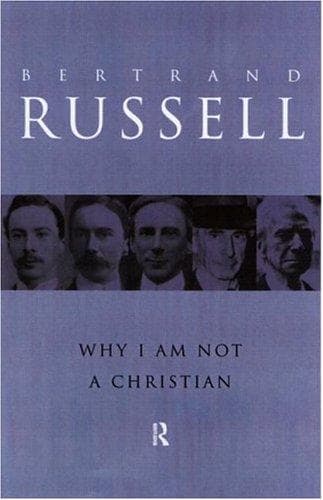
Why I Am Not a Christian and Other Essays on Religion and Related Subjects
لماذا لست مسيحياً ومقالات أخرى حول الدين والموضوعات ذات الصلة
Pourquoi je ne suis pas chrétien et autres essais sur la religion et sujets connexes
Editorial summary
Bertrand Russell's seminal collection brings together essays spanning four decades that systematically dismantle the intellectual foundations of Christianity and religious belief more broadly. The title essay, originally delivered as a 1927 lecture, establishes Russell's central argumentative framework: Christianity fails both as a rational system and as a moral guide. Russell challenges the traditional proofs of God's existence, dismissing the First Cause argument as logically inconsistent (if everything requires a cause, so must God), the natural law argument as confusing description with prescription, and the argument from design as rendered obsolete by Darwin's theory of evolution.
The collection's philosophical significance lies in Russell's application of logical positivism and analytical philosophy to religious questions. Unlike Victorian freethinkers who primarily attacked biblical inconsistencies, Russell employs formal logic and empirical reasoning to demonstrate that religious propositions lack meaningful content. His essay "What I Believe" articulates a naturalistic worldview grounded in scientific method rather than faith, while "Religion and Science" traces the historical retreat of religious explanation before advancing scientific knowledge.
Russell's moral critique proves equally influential. He argues that Christianity's emphasis on sin, punishment, and otherworldly rewards corrupts ethical thinking and retards social progress. The essay "Has Religion Made Useful Contributions to Civilization?" answers emphatically in the negative, documenting how churches opposed scientific advancement, social reform, and humanitarian progress. Russell particularly condemns the doctrine of hell as psychologically damaging and morally repugnant.
The work engages critically with contemporary defenders of religion, including Catholic apologists and liberal theologians who attempt to reconcile faith with modern knowledge. Russell rejects both fundamentalist literalism and modernist reinterpretations as intellectually dishonest. His essay "The Fate of Thomas Paine" illustrates how religious orthodoxy persecutes rational inquiry, while "Our Sexual Ethics" demonstrates religion's harmful influence on human relationships and psychological health.
This collection's enduring importance stems from its comprehensive integration of logical, empirical, historical, and ethical arguments against religious belief. Russell established a template for twentieth-century secular humanism, demonstrating how one might construct a coherent worldview without supernatural foundations. His clear prose and systematic reasoning made philosophical atheism accessible to general readers while maintaining intellectual rigor. The work remains foundational for understanding modern secularism's philosophical underpinnings and its critique of religious authority.
Argument formulations engaged
Related works
Russell, Bertrand (1957). Why I Am Not a Christian and Other Essays on Religion and Related Subjects. George Allen & Unwin.
@book{why-i-am-not-a-christian-and-other-essay,
  author    = {Russell, Bertrand},
  title     = {Why I Am Not a Christian and Other Essays on Religion and Related Subjects},
  year      = {1957},
  publisher = {George Allen & Unwin},
  url       = {https://god-database.com/en/works/why-i-am-not-a-christian-and-other-essays-on-religion-and-related-subjects-1957}
}