
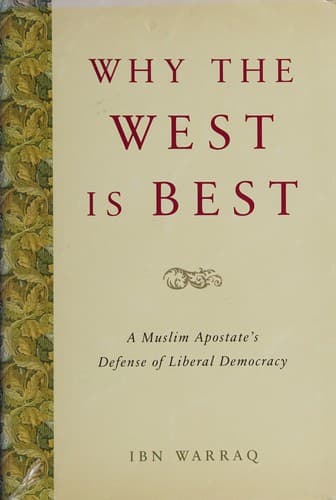
Why the West is Best: A Muslim Apostate's Defense of Liberal Democracy
لماذا الغرب الأفضل: دفاع مرتد مسلم عن الديمقراطية الليبرالية
Pourquoi l'Occident est le Meilleur : La Défense de la Démocratie Libérale par un Apostat Musulman
Editorial summary
Ibn Warraq's Why the West is Best presents a provocative defense of Western liberal democracy from the perspective of an ex-Muslim intellectual. The work situates itself within post-9/11 debates about civilizational conflict, offering a counter-narrative to both Western self-criticism and Islamic apologetics. Warraq argues that Western civilization, grounded in Judeo-Christian values and Enlightenment rationalism, provides the optimal framework for human flourishing, including religious freedom and intellectual inquiry.
The monograph employs comparative cultural analysis, juxtaposing Western and Islamic intellectual traditions to demonstrate what Warraq perceives as the former's superiority. He traces Western achievement through three foundational elements: Greek rationalism, Roman law, and Judeo-Christian ethics. This synthesis, he contends, created unique conditions for scientific advancement, individual liberty, and democratic governance. The author particularly emphasizes how Christianity's eventual accommodation with reason and secular authority contrasts sharply with Islam's resistance to reform.
Warraq's methodology combines historical survey with contemporary political commentary. He examines Western contributions to art, science, and human rights while critiquing Islamic societies for their treatment of women, minorities, and dissenters. The work engages directly with postcolonial theorists and multiculturalists who attribute Western success to exploitation rather than cultural values. Against Edward Said's orientalism thesis, Warraq argues that Western scholarship on Islam often demonstrates greater objectivity than insider perspectives.
The religious dimension permeates the analysis, though Warraq himself writes from a secular standpoint. He credits Christianity's role in shaping Western ethics while celebrating secularization as liberation from religious authority. The work implicitly defends a form of cultural Christianity—valuing Judeo-Christian moral inheritance without theological commitment. This position allows Warraq to appreciate religion's civilizational contributions while maintaining critical distance from supernatural claims.
The monograph's significance lies in its challenge to relativistic approaches to cultural comparison. By defending objective criteria for evaluating civilizations, Warraq reopens questions about progress, truth, and universal values that many academics consider settled. His insider-outsider perspective as an apostate provides unique authority in critiquing Islam while his emigrant status grants intimate knowledge of both civilizations. The work contributes to broader debates about secularization, religious freedom, and the relationship between cultural traditions and political systems.
Argument formulations engaged
Related works
Ibn Warraq (2011). Why the West is Best: A Muslim Apostate's Defense of Liberal Democracy. Encounter Books.
@book{why-the-west-is-best-a-muslim-apostates-,
  author    = {Ibn Warraq},
  title     = {Why the West is Best: A Muslim Apostate's Defense of Liberal Democracy},
  year      = {2011},
  publisher = {Encounter Books},
  url       = {https://god-database.com/en/works/why-the-west-is-best-a-muslim-apostates-defense-of-liberal-democracy-2011}
}