
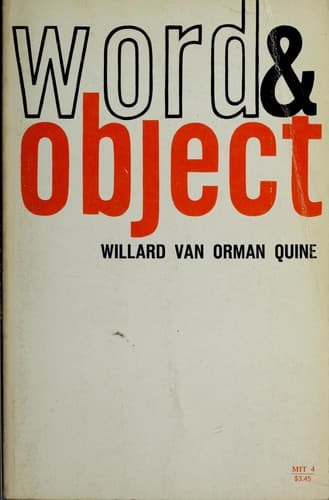
Word and Object
الكلمة والموضوع
Mot et objet
Editorial summary
Word and Object represents Quine's systematic assault on traditional metaphysics and its implications for theological discourse. The work develops a naturalistic philosophy of language that undermines appeals to meanings, essences, and necessary truths - conceptual apparatus frequently deployed in arguments about God's existence and nature.
Central to Quine's project is the thesis of ontological relativity: what exists can only be specified relative to a background language or theory. Through his famous thought experiment of radical translation, Quine demonstrates the indeterminacy of reference - there exists no fact of the matter about what our words refer to independent of a translation manual. When a linguist encounters an unknown language and a native points at a rabbit saying "gavagai," the linguist cannot determine whether this refers to rabbit, undetached rabbit parts, or temporal rabbit stages. This indeterminacy extends to all reference, including reference to God.
Quine's naturalism excludes supernatural entities from serious ontological consideration. His criterion for ontological commitment - "to be is to be the value of a variable" - restricts existence claims to those required by our best scientific theories. Since physics provides our most successful predictive framework without invoking God, divine beings find no place in Quine's austere ontology. Religious language becomes merely a cultural artifact lacking genuine referential import.
The work's critique of the analytic-synthetic distinction further erodes traditional natural theology. Without necessary truths discoverable through pure reason, ontological arguments lose their foundation. Quine's holism implies that even apparently self-evident principles remain revisable in light of experience. Mathematical and logical truths enjoy no special epistemic status that might ground a priori arguments for God's existence.
Quine's physicalism and extensionalism leave no room for irreducible mental properties, souls, or divine minds. His behavioristic approach to language acquisition explains religious discourse as conditioned verbal behavior rather than expression of spiritual insight. The book's sustained argument for methodological monism - applying scientific standards across all domains - challenges religious claims to special epistemic authority.
While Quine avoids explicit atheistic pronouncements, his systematic displacement of the conceptual framework underlying theistic philosophy amounts to a devastating indirect critique. Word and Object exemplifies how rigorous philosophical analysis can render traditional God-talk meaningless without engaging in direct theological debate.
Argument formulations engaged
Related works
Quine, W. V. O. (1960). Word and Object. MIT Press.
@book{word-and-object-1960,
  author    = {Quine, W. V. O.},
  title     = {Word and Object},
  year      = {1960},
  publisher = {MIT Press},
  url       = {https://god-database.com/en/works/word-and-object-1960}
}