
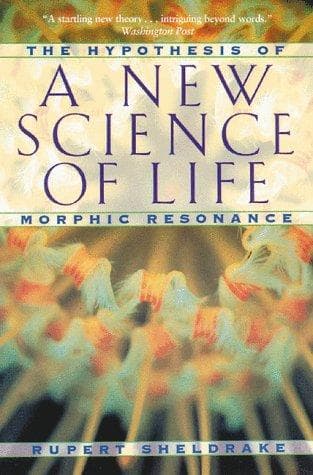
A New Science of Life
علم جديد للحياة
Une nouvelle science de la vie
Editorial summary
This monograph proposes a revolutionary theory of biological development and organization that challenges mechanistic approaches to life sciences. Sheldrake introduces the concept of "morphic resonance" and "morphogenetic fields" to explain how organisms develop their characteristic forms and behaviors. He argues that conventional biochemistry and genetics cannot adequately account for morphogenesis - the process by which organisms take their shape - and proposes that non-material fields guide the development of biological forms through a kind of collective memory inherent in nature.
The work directly confronts the reductionist paradigm dominant in twentieth-century biology, which attempts to explain all biological phenomena through physical and chemical processes alone. Sheldrake contends that while genes specify the proteins organisms can produce, they do not contain a blueprint for form. Instead, he proposes that organisms inherit not only genes but also organize themselves according to morphogenetic fields that have been shaped by previous organisms of the same species. This hypothesis extends beyond individual development to explain instinctive behaviors, arguing that habits of species are transmitted through morphic resonance rather than genetic encoding.
Sheldrake's methodology combines philosophical critique of mechanistic science with experimental proposals to test his hypothesis. He suggests that if organisms can influence others of their species through morphic fields, then new behaviors learned by some individuals should become progressively easier for subsequent individuals to acquire. The work outlines specific experiments involving crystal formation, animal behavior, and human learning that could potentially validate or refute the theory.
The theological implications of Sheldrake's hypothesis, while not explicitly developed in the text, are significant. By proposing non-material causation in nature, the theory opens conceptual space for purpose and memory in the natural world that mechanistic science had eliminated. The work suggests that nature possesses inherent organizing principles that cannot be reduced to matter and energy alone. This perspective aligns with various philosophical and theological traditions that view nature as imbued with non-material properties, though Sheldrake maintains a scientific rather than explicitly religious framework. His challenge to materialism has made the work influential among those seeking to reconcile scientific and spiritual worldviews, while drawing sharp criticism from defenders of mechanistic orthodoxy who view morphic resonance as pseudoscientific.
Argument formulations engaged
Sheldrake, Rupert (1981). A New Science of Life. Icon Books.
@book{a-new-science-of-life-1981,
  author    = {Sheldrake, Rupert},
  title     = {A New Science of Life},
  year      = {1981},
  publisher = {Icon Books},
  url       = {https://god-database.com/en/works/a-new-science-of-life-1981}
}