
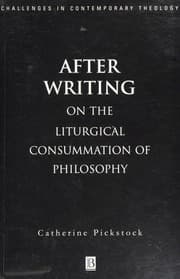
After Writing: On the Liturgical Consummation of Philosophy
بعد الكتابة: عن الإتمام الطقسي للفلسفة
Après l'écriture : Sur la consommation liturgique de la philosophie
Editorial summary
This monograph presents a radical theological critique of modern and postmodern philosophy, arguing that both traditions fundamentally misunderstand language and being due to their rejection of medieval liturgical frameworks. Pickstock traces a genealogy from Plato through medieval scholasticism to demonstrate how the doxological character of language—its inherent orientation toward divine praise—provides the only coherent foundation for meaning and truth. The work contends that post-Scotist philosophy, in severing language from its liturgical context, produces an inevitable nihilism that neither modern rationalism nor postmodern textualism can escape.
The analysis begins with an innovative reading of Plato's Phaedrus, proposing that Socrates' critique of writing anticipates later Christian insights about the incarnational nature of meaningful discourse. Pickstock argues that authentic philosophy requires oral presence and communal participation, qualities perfected in the medieval Latin liturgy. The central chapters examine how Duns Scotus inaugurates modernity by conceiving being as univocal rather than analogical, thereby eliminating the participatory metaphysics that grounded earlier Christian thought. This shift, she maintains, makes God merely another being among beings rather than the transcendent source of all existence.
The work's most provocative claim concerns the Roman Rite's pre-modern form as philosophy's proper culmination. Pickstock argues that the traditional Latin Mass embodies a sophisticated semiotics where signs genuinely convey divine presence through transubstantiation. This liturgical consummation resolves aporias that plague secular philosophy: the relationship between time and eternity, presence and absence, immanence and transcendence. Modern liturgical reforms, influenced by the same rationalist assumptions that corrupt secular thought, destroy this delicate semiotic achievement.
Engaging primarily with postmodern thinkers like Derrida while drawing extensively on patristic and medieval sources, Pickstock positions her argument within the Radical Orthodoxy movement. The work challenges both secular philosophy's claimed autonomy and liberal theology's accommodations to modernity. By insisting that coherent meaning depends upon doxological orientation, the text offers a comprehensive theological alternative to contemporary philosophical discourse. The argument's significance lies in its bold claim that philosophy without liturgy inevitably collapses into nihilism, suggesting that the God question cannot be bracketed as merely one topic among others but determines the very possibility of rational discourse.
Argument formulations engaged
Related works
Pickstock, Catherine (1998). After Writing: On the Liturgical Consummation of Philosophy. Wiley-Blackwell.
@book{after-writing-on-the-liturgical-consumma,
  author    = {Pickstock, Catherine},
  title     = {After Writing: On the Liturgical Consummation of Philosophy},
  year      = {1998},
  publisher = {Wiley-Blackwell},
  url       = {https://god-database.com/en/works/after-writing-on-the-liturgical-consummation-of-philosophy-1998}
}