
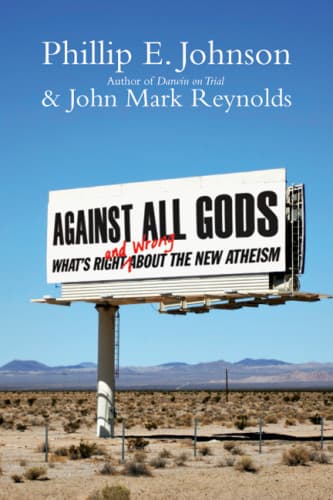
Against All Gods: What's Right and Wrong About the New Atheism
ضد جميع الآلهة: ما هو الصحيح والخطأ في الإلحاد الجديد
Contre Tous les Dieux : Ce qui est Juste et Faux à Propos du Nouvel Athéisme
Editorial summary
John Mark Reynolds presents a philosophical critique of the New Atheism movement, examining both its legitimate criticisms of religious belief and what he considers its fundamental intellectual shortcomings. Writing as a Christian philosopher, Reynolds engages primarily with the arguments of Richard Dawkins, Christopher Hitchens, Sam Harris, and Daniel Dennett, acknowledging certain valid points in their critique of religion while arguing that their overall case against theism fails on multiple grounds.
Reynolds concedes that the New Atheists correctly identify genuine problems within religious communities, including anti-intellectualism, moral failures, and the misuse of faith to justify harmful actions. He agrees that these critics perform a valuable service in challenging complacent or poorly reasoned religious beliefs. However, he contends that their critique suffers from three major weaknesses: philosophical superficiality, historical ignorance, and rhetorical excess.
The work argues that the New Atheists demonstrate insufficient engagement with sophisticated philosophical arguments for theism, often attacking simplistic versions of religious belief rather than addressing the strongest formulations developed over centuries of theological and philosophical reflection. Reynolds particularly criticizes their treatment of arguments from design, morality, and consciousness, suggesting they dismiss these too hastily without grappling with their most rigorous presentations.
Reynolds also challenges what he sees as the New Atheists' selective and distorted reading of history, particularly their narrative about the relationship between religion and science. He argues they overstate conflicts while ignoring the positive contributions of religious thinkers to scientific and intellectual progress. The work examines specific historical examples to counter the narrative of inevitable warfare between faith and reason.
The rhetorical dimension receives significant attention, with Reynolds arguing that the New Atheists' polemical style, while effective in garnering popular attention, ultimately undermines productive dialogue between believers and non-believers. He suggests their approach creates more heat than light, polarizing discussions rather than advancing mutual understanding.
Throughout, Reynolds advocates for a more charitable and intellectually rigorous engagement between theists and atheists. He proposes that both sides would benefit from acknowledging the genuine insights of their opponents while maintaining higher standards of philosophical argumentation. The work represents an attempt at constructive criticism, seeking to move beyond mere apologetics toward a more fruitful exchange of ideas about fundamental questions of existence, meaning, and morality.
Argument formulations engaged
Related works
Reynolds, John Mark (2010). Against All Gods: What's Right and Wrong About the New Atheism. InterVarsity Press.
@book{against-all-gods-whats-right-and-wrong-a,
  author    = {Reynolds, John Mark},
  title     = {Against All Gods: What's Right and Wrong About the New Atheism},
  year      = {2010},
  publisher = {InterVarsity Press},
  url       = {https://god-database.com/en/works/against-all-gods-whats-right-and-wrong-about-the-new-atheism-2010}
}