
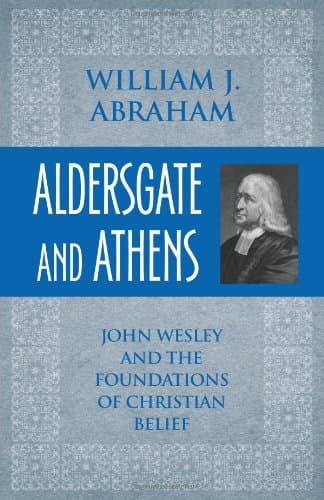
Aldersgate and Athens: John Wesley and the Foundations of Christian Belief
ألدرسجيت وأثينا: جون ويسلي وأسس الإيمان المسيحي
Aldersgate et Athènes : John Wesley et les Fondements de la Croyance Chrétienne
Editorial summary
This monograph examines John Wesley's epistemology and its implications for understanding religious knowledge and Christian belief. Abraham analyzes how Wesley navigated between empiricist philosophy and evangelical experience, developing a distinctive approach to religious epistemology that combined reason, scripture, tradition, and experience—what later theologians would call the Wesleyan Quadrilateral. The work contributes to debates about religious knowledge by demonstrating how Wesley's synthesis offers a middle path between pure rationalism and uncritical fideism.
Abraham argues that Wesley's Aldersgate experience in 1738 fundamentally shaped his understanding of how believers come to know God, yet this experiential emphasis never displaced Wesley's commitment to rational inquiry. The author traces Wesley's intellectual debts to Lockean empiricism and Anglican theological tradition while showing how Wesley modified these influences through his emphasis on the internal witness of the Holy Spirit. This pneumatological dimension distinguishes Wesley's epistemology from both Enlightenment rationalism and contemporary evangelical anti-intellectualism.
The monograph engages critically with interpretations that portray Wesley as either a proto-liberal theologian or an unreflective enthusiast. Abraham demonstrates that Wesley maintained a sophisticated balance between objective theological claims and subjective religious experience. He examines Wesley's sermons, journals, and theological treatises to show how Wesley understood religious knowledge as involving both propositional content and personal transformation. This analysis challenges reductionist accounts that separate theology from spirituality or doctrine from experience.
Abraham's work intervenes in contemporary discussions about religious epistemology by retrieving Wesley's insights for current debates. He argues that Wesley's approach offers resources for responding to both secular skepticism and religious fundamentalism. The integration of Athens (philosophical reasoning) and Aldersgate (transformative experience) provides a model for understanding how rational inquiry and spiritual experience can mutually inform religious belief without compromising either dimension.
The monograph's significance lies in its demonstration that Wesley's epistemology represents a coherent alternative to post-Enlightenment dichotomies between faith and reason. Abraham shows how Wesley's methodology anticipates later developments in Reformed epistemology while maintaining distinctive emphasis on the role of grace in human knowing. This historical retrieval offers constructive possibilities for contemporary Christian philosophy, suggesting ways to articulate religious knowledge claims that acknowledge both their rational warrant and their existential dimension.
Argument formulations engaged
Related works
Abraham, William J. (2010). Aldersgate and Athens: John Wesley and the Foundations of Christian Belief. Baylor University Press.
@book{aldersgate-and-athens-john-wesley-and-th,
  author    = {Abraham, William J.},
  title     = {Aldersgate and Athens: John Wesley and the Foundations of Christian Belief},
  year      = {2010},
  publisher = {Baylor University Press},
  url       = {https://god-database.com/en/works/aldersgate-and-athens-john-wesley-and-the-foundations-of-christian-belief-2010}
}