
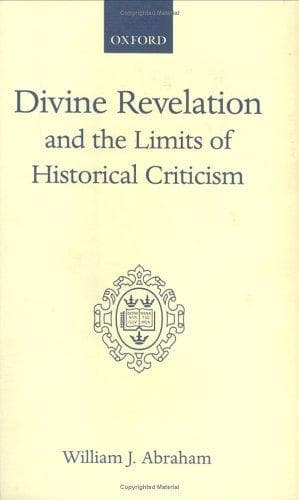
Divine Revelation and the Limits of Historical Criticism
الوحي الإلهي وحدود النقد التاريخي
Révélation divine et les limites de la critique historique
Editorial summary
This monograph examines the relationship between divine revelation and historical-critical methods in biblical studies, arguing that modern scholarship has created artificial limitations on understanding revelation by privileging naturalistic historical approaches. Abraham contends that the dominant paradigm of historical criticism, while valuable for certain textual and contextual insights, systematically excludes the possibility of genuine divine action and communication, thereby distorting theological inquiry from the outset.
The work develops its argument through three main movements. First, Abraham traces the emergence of historical criticism in biblical studies, demonstrating how Enlightenment presuppositions about causality and evidence became embedded in scholarly methodology. He argues that these methods, while claiming neutrality, actually import metaphysical assumptions that preclude divine agency. Second, he examines specific cases where historical-critical approaches have struggled to account for biblical claims about revelation, prophecy, and miracle. Abraham suggests these difficulties arise not from the texts themselves but from the interpretive frameworks imposed upon them. Third, he proposes an alternative approach that maintains scholarly rigor while remaining open to supernatural explanation and divine communication.
Abraham's critique engages particularly with the German tradition of biblical criticism, including figures like Troeltsch and Bultmann, whose methodological naturalism he sees as unnecessarily restrictive. He argues against scholars who treat religious texts merely as human documents reflecting social and psychological forces, insisting instead that theology must take seriously the possibility that God has acted in history and spoken through human authors. This position places him in conversation with both conservative scholars who reject historical criticism entirely and liberal scholars who embrace it uncritically.
The monograph's significance lies in its sophisticated attempt to navigate between fundamentalist rejection of critical methods and naturalistic reductionism. Abraham seeks to preserve the gains of historical scholarship while challenging its philosophical limitations. His work contributes to ongoing debates about the relationship between faith and reason, the nature of religious knowledge, and the proper methods for studying sacred texts. By arguing that historical criticism's self-imposed boundaries prevent it from adequately engaging with revelation claims, Abraham opens space for a more philosophically generous approach to biblical interpretation that neither abandons critical inquiry nor excludes divine action a priori. This intervention remains relevant to contemporary discussions about methodology in religious studies and the epistemic status of theological claims.
Argument formulations engaged
Related works
Abraham, William J. (1982). Divine Revelation and the Limits of Historical Criticism. Oxford University Press.
@book{divine-revelation-and-the-limits-of-hist,
  author    = {Abraham, William J.},
  title     = {Divine Revelation and the Limits of Historical Criticism},
  year      = {1982},
  publisher = {Oxford University Press},
  url       = {https://god-database.com/en/works/divine-revelation-and-the-limits-of-historical-criticism-1982}
}