
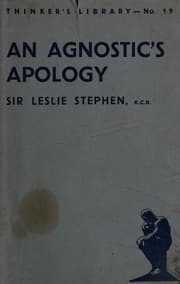
An Agnostic's Apology
اعتذار اللاأدري
Apologie d'un agnostique
Editorial summary
Stephen's "An Agnostic's Apology" presents a vigorous defense of religious skepticism against Victorian Christianity, establishing agnosticism not as intellectual weakness but as the only intellectually honest position given the limits of human knowledge. Writing in response to religious critics who characterized agnosticism as cowardly fence-sitting, Stephen argues that the truly courageous stance involves admitting ignorance where evidence is lacking rather than manufacturing certainty through faith or wishful thinking.
The work systematically dismantles claims to religious knowledge through empirical and logical analysis. Stephen contends that theological propositions about God's nature, divine providence, and the afterlife fundamentally exceed human cognitive capacities. He particularly targets natural theology's attempts to prove God's existence through design arguments, maintaining that such reasoning projects human categories onto cosmic phenomena without justification. The problem is not merely insufficient evidence but the categorical impossibility of obtaining evidence about transcendent matters through finite human faculties.
Stephen engages directly with contemporary theological modernizers who sought to preserve Christianity by reinterpreting doctrine metaphorically or morally. He argues that such liberal theology represents an unstable halfway house, retaining religious language while evacuating its substantive content. If God-talk reduces to ethical exhortation or poetic sentiment, Stephen suggests, then honest thinkers should abandon theological terminology altogether rather than perpetuate confusion through equivocation.
The essay collection addresses the moral implications of agnosticism, countering charges that religious skepticism undermines ethics and social order. Stephen maintains that morality requires no supernatural foundation, deriving instead from human sympathy and social evolution. He presents agnosticism as intellectually liberating, freeing minds from dogmatic constraints while encouraging genuine inquiry into questions amenable to human investigation.
Methodologically, Stephen combines British empiricism with evolutionary thinking, reflecting his position within Victorian scientific naturalism. His approach anticipates later logical positivist critiques of religious language while maintaining a more moderate tone that acknowledges religion's psychological and social functions. The work's significance lies in articulating agnosticism as a distinct philosophical position rather than mere indecision, establishing frameworks that would influence subsequent debates about evidentialism, the burden of proof, and the relationship between knowledge claims and religious belief. Stephen transforms agnosticism from a perceived weakness into an epistemic virtue, demanding that belief proportions itself to evidence.
Argument formulations engaged
Related works
Stephen, Leslie (1876). An Agnostic's Apology. Fortnightly Review.
@book{an-agnostics-apology-1876,
  author    = {Stephen, Leslie},
  title     = {An Agnostic's Apology},
  year      = {1876},
  publisher = {Fortnightly Review},
  url       = {https://god-database.com/en/works/an-agnostics-apology-1876}
}