
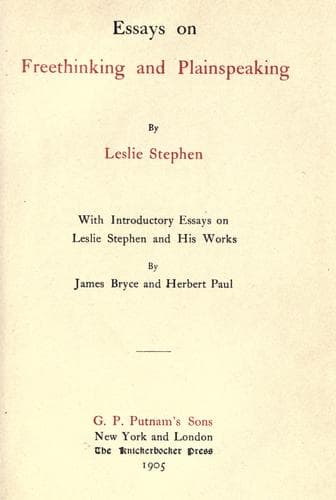
Essays on Freethinking and Plainspeaking
مقالات في حرية الفكر ووضوح التعبير
Essais sur la libre pensée et le parler franc
Editorial summary
This collection of essays represents Leslie Stephen's systematic critique of religious orthodoxy and defense of rational inquiry in Victorian England. Writing as a prominent intellectual and former Anglican clergyman who had renounced his orders, Stephen articulates a comprehensive case for freethinking as both intellectual necessity and moral imperative in the face of religious dogmatism.
The essays employ a dual methodological approach. First, Stephen conducts historical analysis of religious beliefs, demonstrating their evolution and cultural contingency. He argues that doctrines presented as eternal truths reveal themselves as products of specific historical circumstances when subjected to scholarly scrutiny. Second, he applies philosophical criticism to theological claims, exposing logical inconsistencies and empirical inadequacies in traditional religious arguments. His critique extends beyond Christianity to encompass supernatural beliefs generally, though Anglican orthodoxy remains his primary target given its cultural dominance.
Stephen's intellectual framework draws heavily from contemporary scientific naturalism and German biblical criticism. He positions religious belief as an impediment to both scientific progress and moral development, arguing that adherence to orthodoxy requires intellectual dishonesty. The essays particularly emphasize how religious institutions demand conformity through social pressure rather than rational persuasion. Stephen contends that true morality emerges from human reason and experience rather than divine command, anticipating later secular ethical systems.
The work's significance lies in its articulation of agnostic philosophy for an educated Victorian readership. Stephen distinguishes his position from crude atheism, maintaining that while positive religious claims lack justification, absolute denial of divine existence exceeds available evidence. This measured skepticism influenced subsequent freethinkers and contributed to the broader secularization of British intellectual life. His emphasis on "plainspeaking" - direct expression of heterodox views despite social consequences - challenged Victorian conventions of religious deference.
Stephen's arguments engage contemporary defenders of orthodoxy, particularly those attempting to reconcile traditional belief with modern science. He rejects such compromises as intellectually incoherent, insisting that honest inquiry leads inevitably toward agnosticism. The essays thus function both as philosophical arguments and as manifestos for intellectual courage, calling readers to embrace uncertainty rather than cling to comforting but unfounded beliefs. Their influence extended through Stephen's role in founding the journal that became Mind and his mentorship of younger skeptical thinkers.
Argument formulations engaged
Related works
Stephen, Leslie (1873). Essays on Freethinking and Plainspeaking. Longmans, Green.
@book{essays-on-freethinking-and-plainspeaking,
  author    = {Stephen, Leslie},
  title     = {Essays on Freethinking and Plainspeaking},
  year      = {1873},
  publisher = {Longmans, Green},
  url       = {https://god-database.com/en/works/essays-on-freethinking-and-plainspeaking-1873}
}