
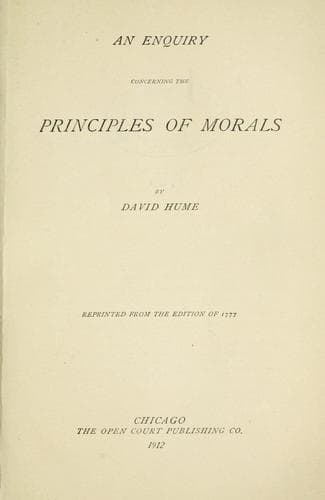
An Enquiry Concerning the Principles of Morals
بحث في مبادئ الأخلاق
Enquête sur les principes de la morale
Editorial summary
This treatise examines the foundations of morality through empirical investigation, developing arguments that significantly challenge traditional theistic ethics. Hume applies his experimental method to moral philosophy, seeking to ground ethical principles in human nature rather than divine command or rational intuition. While ostensibly focused on ethics, the work carries profound implications for natural theology and religious apologetics.
The enquiry proceeds by analyzing moral sentiments and their origins in human psychology. Hume argues that moral distinctions arise from feelings of approval and disapproval rather than from reason or divine revelation. He locates the source of these sentiments in sympathy and utility, demonstrating how moral judgments emerge from consideration of actions' effects on human happiness and social wellbeing. This naturalistic account directly opposes theological ethics that ground morality in God's will or eternal law.
Central to Hume's argument is the rejection of rationalist approaches to ethics, whether secular or religious. He maintains that reason alone cannot motivate action or establish moral obligations. This position undermines attempts to derive ethics from contemplation of divine perfection or rational theology. By showing that morality depends on sentiment rather than abstract reasoning, Hume challenges both scholastic natural law theory and contemporary rational religion.
The work's treatment of justice proves particularly significant for religious thought. Hume presents justice as an artificial virtue arising from social convention rather than divine ordinance. This conventionalist account contradicts theological teachings about natural justice inscribed by God in human nature. His analysis suggests that moral order emerges through human agreement rather than divine design.
Hume's methodology reflects broader Enlightenment tensions with religious authority. By applying Newtonian experimental philosophy to moral questions, he claims ethics as territory for empirical investigation rather than theological speculation. His consistent naturalism excludes supernatural explanations for moral phenomena, treating ethics as continuous with other aspects of human nature subject to scientific study.
The enquiry's influence extends beyond moral philosophy to fundamental questions about religion's role in ethics. By demonstrating that morality can be explained without reference to God, Hume provides crucial support for secular ethics. His sentimentalist theory offers an alternative to divine command theory, showing how moral obligation might exist without supernatural sanction. This contribution remains central to debates about whether morality requires religious foundations.
Argument formulations engaged
Related works
Hume, David (1751). An Enquiry Concerning the Principles of Morals. A. Millar.
@book{an-enquiry-concerning-the-principles-of-,
  author    = {Hume, David},
  title     = {An Enquiry Concerning the Principles of Morals},
  year      = {1751},
  publisher = {A. Millar},
  url       = {https://god-database.com/en/works/an-enquiry-concerning-the-principles-of-morals-1751}
}