
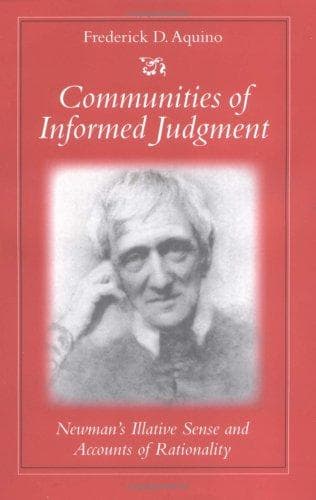
Communities of Informed Judgment: Newman's Illative Sense and Accounts of Rationality
جماعات الحكم المطلع: الحس الاستدلالي لنيومان وتفسيرات العقلانية
Communautés de jugement éclairé : Le sens illatif de Newman et les comptes rendus de rationalité
Editorial summary
This monograph examines John Henry Newman's concept of the illative sense as a distinctive contribution to understanding religious rationality and belief formation. Aquino situates Newman's epistemology within contemporary debates about the rationality of religious belief, arguing that Newman's account offers a sophisticated alternative to both narrow evidentialism and uncritical fideism. The work demonstrates how Newman's illative sense provides a framework for understanding how individuals reach certitude in matters of faith through the convergence of probable arguments and personal judgment.
Central to Aquino's analysis is Newman's distinction between formal logic and the actual process by which people form beliefs about complex realities, including religious truths. The illative sense represents the mind's capacity to judge the cumulative force of converging probabilities and reach conclusions that, while not demonstrable through strict logical proof, achieve genuine certitude. Aquino shows how Newman developed this concept partly in response to the evidentialist challenges of his day, particularly those posed by William Clifford and the scientific rationalism of the Victorian era.
The monograph carefully traces how Newman's approach anticipates and addresses concerns raised by later epistemologists. Aquino demonstrates that the illative sense is not merely subjective intuition but operates within what Newman calls "communities of informed judgment." These communities provide the interpretive contexts and accumulated wisdom necessary for proper judgment in specialized domains, whether scientific, historical, or religious. This social dimension of Newman's epistemology, Aquino argues, offers resources for understanding how rational belief formation occurs within traditions while avoiding both relativism and authoritarianism.
Aquino's work contributes significantly to debates about religious epistemology by showing how Newman's account navigates between purely propositional approaches to faith and anti-intellectual alternatives. The analysis reveals how the illative sense allows for genuine rational assessment of religious claims while acknowledging the personal and communal dimensions of belief formation. By connecting Newman's insights to contemporary discussions in reformed epistemology and virtue epistemology, Aquino demonstrates the continued relevance of Newman's thought for understanding how reasonable people can arrive at religious convictions. The monograph thus presents Newman's epistemology as a viable framework for defending the rationality of religious belief without reducing faith to either logical demonstration or arbitrary choice.
Argument formulations engaged
Related works
Aquino, Frederick D. (2004). Communities of Informed Judgment: Newman's Illative Sense and Accounts of Rationality.
@book{communities-of-informed-judgment-newmans,
  author    = {Aquino, Frederick D.},
  title     = {Communities of Informed Judgment: Newman's Illative Sense and Accounts of Rationality},
  year      = {2004},
  url       = {https://god-database.com/en/works/communities-of-informed-judgment-newmans-illative-sense-and-accounts-of-rationality-2004}
}