
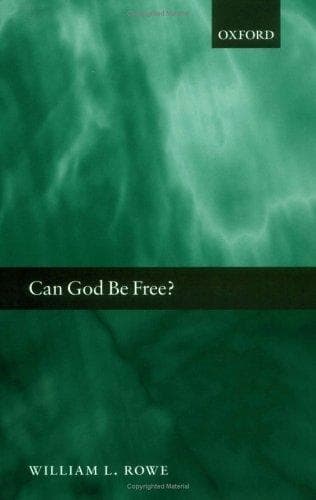
Can God Be Free?
هل يمكن أن يكون الله حراً؟
Dieu peut-il être libre ?
Editorial summary
William Rowe's "Can God Be Free?" examines a fundamental tension in philosophical theology: whether an omnipotent, omniscient, and perfectly good God possesses genuine freedom in creation. The monograph challenges the coherence of divine freedom when combined with traditional theistic attributes, developing what becomes known as the "Rowe dilemma."
Rowe argues that if God is perfectly good, omniscient, and omnipotent, then God must create the best possible world. This necessity, however, appears to eliminate divine freedom. The argument proceeds through careful analysis of modal logic and moral obligation. If multiple equally good possible worlds exist, God might choose freely among them. However, Rowe contends that a perfectly good being would be obligated to create some best world rather than create nothing or create an inferior world. This generates a dilemma: either God lacks freedom in creation, or God lacks perfect goodness.
The work engages critically with libertarian responses that attempt to preserve both divine freedom and perfect goodness. Rowe examines various escape routes, including appeals to divine grace, the claim that no best possible world exists, and arguments that God's goodness differs categorically from creaturely goodness. He finds these responses ultimately unsatisfactory, maintaining that they either compromise divine perfection or merely relocate rather than resolve the problem.
Rowe's analysis draws on the Leibnizian tradition while developing original insights about the relationship between divine attributes. His methodology combines analytic precision with attention to theological implications, demonstrating how abstract metaphysical questions bear directly on religious understanding. The monograph situates itself within contemporary debates about perfect being theology, engaging with figures like Thomas Morris, Richard Swinburne, and Norman Kretzmann.
The significance of Rowe's argument extends beyond technical philosophy of religion. If successful, it challenges classical theism's coherence and suggests that believers must either revise their conception of divine attributes or accept that God's creative act lacks the freedom traditionally ascribed to it. The work exemplifies how rigorous philosophical analysis can generate surprising challenges to longstanding religious doctrines. While some theologians might embrace divine determinism as expressing God's perfect nature, Rowe shows why this move carries costs that many theists find unacceptable. His careful argumentation has sparked extensive debate about whether perfect being theology contains internal contradictions requiring fundamental revision.
Argument formulations engaged
Related works
Rowe, William (2004). Can God Be Free?. Oxford University Press.
@book{can-god-be-free-2004,
  author    = {Rowe, William},
  title     = {Can God Be Free?},
  year      = {2004},
  publisher = {Oxford University Press},
  url       = {https://god-database.com/en/works/can-god-be-free-2004}
}