
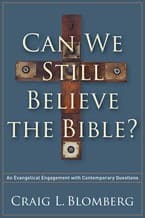
Can We Still Believe in the Gospels?
هل لا يزال بإمكاننا الإيمان بالأناجيل؟
Pouvons-nous encore croire aux Évangiles ?
Editorial summary
This monograph presents a systematic defense of the historical reliability of the canonical Gospels, engaging contemporary skeptical scholarship that questions their trustworthiness. Blomberg addresses six major challenges to Gospel credibility: the reliability of oral tradition, apparent contradictions between Gospel accounts, the genre classification of the Gospels, authorship questions, the relationship between theology and history, and claims of miraculous events.
The work employs historical-critical methodology while maintaining evangelical commitments, examining each challenge through careful analysis of ancient literary conventions, archaeological evidence, and comparative historical texts. Blomberg argues that modern skepticism often applies anachronistic standards to ancient texts, failing to understand first-century compositional practices. He demonstrates how apparent contradictions dissolve when one considers ancient biographical conventions, paraphrasing practices, and narrative compression techniques common in Greco-Roman literature.
Regarding oral tradition, Blomberg draws on recent studies showing how ancient Mediterranean cultures preserved historical memories with remarkable accuracy through formal and informal channels. He contends that the time gap between Jesus's ministry and Gospel composition falls well within the range for reliable oral preservation. On authorship, he defends traditional attributions while acknowledging scholarly debates, arguing that even if the traditional authors did not write the Gospels, this would not necessarily undermine their historical value.
The monograph engages directly with scholars like Bart Ehrman, John Dominic Crossan, and the Jesus Seminar, offering detailed rebuttals to their skeptical conclusions. Blomberg particularly critiques their methodological assumptions, arguing they often begin with naturalistic presuppositions that predetermine their conclusions about miraculous accounts. He maintains that historians should remain open to supernatural explanations when evaluating ancient testimonies about extraordinary events.
The work's significance lies in its comprehensive treatment of contemporary challenges to Gospel reliability from within mainstream biblical scholarship rather than from fundamentalist apologetics. Blomberg demonstrates extensive familiarity with critical scholarship while offering substantive counterarguments. His approach models how conservative scholars can engage seriously with critical methods while maintaining traditional Christian commitments about biblical authority. The monograph serves as both an introduction for general readers and a scholarly resource, providing extensive bibliographies for further research. By defending the Gospels' historical reliability, Blomberg implicitly supports their theological claims about Jesus's identity and divine mission, making this work a significant contribution to debates about religious epistemology and the rational grounds for Christian belief.
Argument formulations engaged
Blomberg, Craig L. (2016). Can We Still Believe in the Gospels?. Brazos Press.
@book{can-we-still-believe-in-the-gospels-2016,
  author    = {Blomberg, Craig L.},
  title     = {Can We Still Believe in the Gospels?},
  year      = {2016},
  publisher = {Brazos Press},
  url       = {https://god-database.com/en/works/can-we-still-believe-in-the-gospels-2016}
}