
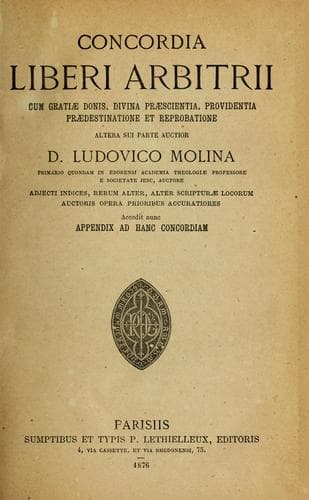
Concordia Liberi Arbitrii cum Gratiae Donis
توافق الإرادة الحرة مع عطايا النعمة
Editorial summary
Luis de Molina's Concordia Liberi Arbitrii cum Gratiae Donis represents a watershed moment in Christian philosophical theology, offering an innovative solution to the perennial tension between divine sovereignty and human freedom. Written during the height of Counter-Reformation theological debates, this work emerges from Molina's engagement with both Protestant reformers who emphasized divine predestination and fellow Catholics who struggled to articulate how human free will operates under divine grace.
Molina's central contribution lies in his doctrine of scientia media or middle knowledge, which posits that God possesses knowledge of all possible counterfactual truths about free human actions. This divine knowledge stands between God's natural knowledge of all possibilities and his free knowledge of actual creation. Through middle knowledge, God comprehends what any free creature would choose in any given circumstance, enabling him to actualize a world that achieves his providential purposes while preserving genuine human freedom.
The work systematically addresses objections from both Augustinian and Thomistic positions that prioritize divine causation in human salvation. Against the Báñezian theory of physical premotion, which holds that God moves the human will through an intrinsic divine impulse, Molina argues for a concurrent model where divine and human agencies operate simultaneously without compromising either. His analysis draws extensively from Aristotelian metaphysics while engaging contemporary scholastic disputations, particularly those emerging from the University of Salamanca.
Molina's argumentation proves significant for several reasons. First, it provides philosophical tools for defending human moral responsibility within a theistic framework, countering both theological determinism and nascent mechanistic philosophies. Second, it offers a sophisticated account of providence that avoids making God the author of evil while maintaining his omniscience and sovereignty. Third, the theory influences subsequent debates about divine foreknowledge, inspiring both Catholic and Protestant thinkers to reconsider the relationship between eternity and temporal contingency.
The Concordia's impact extends beyond its immediate theological context. By articulating how divine knowledge can encompass free creaturely actions without determining them, Molina provides resources for contemporary discussions about theological compatibilism, the problem of evil, and divine providence. His middle knowledge theory continues to generate philosophical debate, with modern analytic philosophers of religion examining whether such knowledge is metaphysically possible and whether it successfully reconciles libertarian freedom with robust divine providence.
Argument formulations engaged
Related works
Molina, Luis de (1588). Concordia Liberi Arbitrii cum Gratiae Donis.
@book{concordia-liberi-arbitrii-cum-gratiae-do,
  author    = {Molina, Luis de},
  title     = {Concordia Liberi Arbitrii cum Gratiae Donis},
  year      = {1588},
  url       = {https://god-database.com/en/works/concordia-liberi-arbitrii-cum-gratiae-donis-1588}
}