
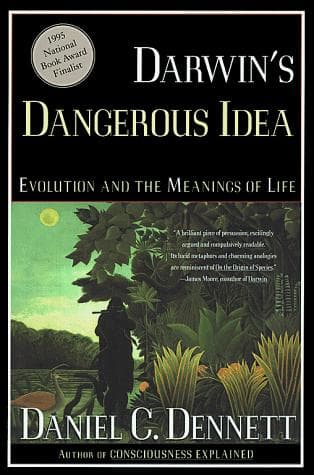
Darwin's Dangerous Idea: Evolution and the Meanings of Life
فكرة داروين الخطيرة: التطور ومعاني الحياة
L'idée dangereuse de Darwin : L'évolution et les significations de la vie
Editorial summary
Daniel Dennett's "Darwin's Dangerous Idea" presents evolutionary theory as a universal acid that dissolves traditional philosophical and religious concepts, particularly those concerning divine design and human purpose. The work systematically explores how Darwinian natural selection operates as an algorithmic process that requires no intelligent oversight, thereby challenging fundamental assumptions about creation, consciousness, and meaning that have historically supported theistic worldviews.
Dennett characterizes evolution through natural selection as a mindless, mechanical procedure that nevertheless produces all the apparent design and complexity observed in nature. He argues that this "dangerous idea" extends far beyond biology, corroding cherished beliefs about human uniqueness, moral foundations, and cosmic purpose. The text engages directly with contemporary critics of evolutionary theory, including both religious opponents and secular philosophers who resist the full implications of Darwin's insight. Dennett particularly targets what he terms "skyhooks" - miraculous interventions or top-down explanations that attempt to preserve special status for consciousness, culture, or human meaning within an otherwise naturalistic framework.
The work's central philosophical contribution lies in its thoroughgoing naturalism. Dennett contends that accepting evolution means abandoning not just creationism but also various forms of soft dualism and emergentism that preserve quasi-religious notions of irreducible meaning or purpose. He develops the concept of "cranes" - legitimate bottom-up explanations that build complexity through natural processes - as the only acceptable alternative to supernatural skyhooks. This approach explicitly challenges theologians like Richard Swinburne and Alvin Plantinga, as well as scientists like Stephen Jay Gould who attempt to maintain separate magisteria for science and religion.
Methodologically, Dennett employs philosophical analysis combined with extensive engagement with biological literature, cognitive science, and artificial intelligence research. He draws particularly on work by Richard Dawkins, extending the gene-centered view of evolution into a comprehensive worldview that explains minds, meanings, and morals as products of evolutionary algorithms. The text functions as both a defense of ultra-Darwinism against its critics and a manifesto for extending evolutionary thinking into every domain traditionally reserved for religious or humanistic explanation. Dennett's unflinching materialism and his insistence that Darwin's idea leaves no room for cosmic purpose or divine action establish this work as a cornerstone text in contemporary naturalistic philosophy, one that explicitly positions evolutionary theory as incompatible with any meaningful conception of God or transcendent purpose.
Argument formulations engaged
Related works
Dennett, Daniel C. (1995). Darwin's Dangerous Idea: Evolution and the Meanings of Life. Simon & Schuster.
@book{darwins-dangerous-idea-evolution-and-the,
  author    = {Dennett, Daniel C.},
  title     = {Darwin's Dangerous Idea: Evolution and the Meanings of Life},
  year      = {1995},
  publisher = {Simon & Schuster},
  url       = {https://god-database.com/en/works/darwins-dangerous-idea-evolution-and-the-meanings-of-life-1995}
}