
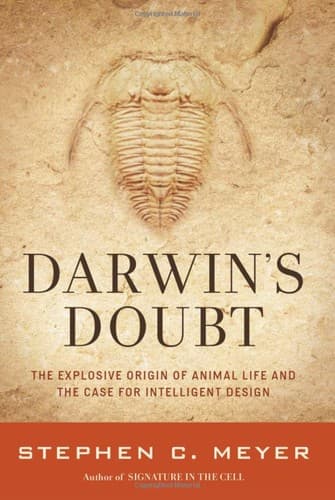
Darwin's Doubt
شك داروين
Le Doute de Darwin
The abrupt appearance of dozens of animal phyla in the Cambrian explosion constitutes a profound challenge to Darwinian gradualism, and the best scientific explanation for the origin of the biological information required is an intelligent cause.
Editorial summary
Stephen C. Meyer's Darwin's Doubt presents a comprehensive challenge to neo-Darwinian evolutionary theory through examination of the Cambrian explosion, arguing that this geological event provides compelling evidence for intelligent design. The work engages primarily with contemporary evolutionary biology and paleontology, positioning itself against the explanatory adequacy of naturalistic mechanisms to account for the rapid appearance of complex animal body plans approximately 530 million years ago.
Meyer employs abductive reasoning throughout, arguing that intelligent design provides the best explanation for the origin of biological information necessary to construct new animal forms. He systematically examines the fossil record of the Cambrian period, highlighting what he considers insurmountable difficulties for gradualistic evolutionary explanations. The argument proceeds through careful analysis of morphological complexity, the requisite genetic and epigenetic information systems, and the mathematical improbabilities associated with random mutation and natural selection generating novel body plans within available timeframes.
The work engages extensively with mainstream paleontologists and evolutionary biologists, including Simon Conway Morris, James Valentine, and Douglas Erwin, while also drawing upon information theory and probability calculations. Meyer contends that the Cambrian explosion represents not merely an increase in diversity within existing forms but the geologically sudden appearance of fundamentally new animal architectures requiring vast amounts of specified complexity. This complexity, he argues, points toward purposive causation rather than undirected natural processes.
Operating within the Christian analytic tradition while maintaining scientific methodology, Meyer advances a modern version of the design argument that directly challenges methodological naturalism in biological origins research. His approach differs from earlier intelligent design arguments by focusing specifically on paleontological discontinuity and information generation rather than irreducible complexity in existing organisms.
The monograph's significance lies in its sophisticated engagement with current scientific literature while arguing for theistic implications. Meyer presents intelligent design not as a science stopper but as a positive research program capable of making testable predictions about biological history. While controversial within mainstream science, the work represents a serious attempt to demonstrate that empirical evidence from the Cambrian explosion supports inference to intelligent causation, thereby contributing to broader discussions about the relationship between scientific evidence and theistic belief.
Structured analysis
Argument formulations engaged
Related works
Meyer, Stephen C. (2013). Darwin's Doubt. HarperCollins.
@book{darwins-doubt,
  author    = {Meyer, Stephen C.},
  title     = {Darwin's Doubt},
  year      = {2013},
  publisher = {HarperCollins},
  url       = {https://god-database.com/en/works/darwins-doubt}
}