
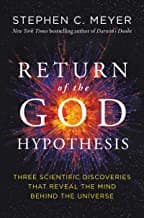
Return of the God Hypothesis
عودة فرضية الإله
Le Retour de l'hypothèse de Dieu
The convergence of evidence from cosmology, physics, and biology — including the Big Bang, fine-tuning, and the digital information encoded in DNA — constitutes a compelling scientific case for the existence of an intelligent, personal God.
Editorial summary
Stephen C. Meyer's Return of the God Hypothesis presents a comprehensive case for theism through scientific argumentation, examining three pivotal scientific discoveries that Meyer contends point toward intelligent design. The work represents a significant contribution to natural theology within the Christian analytic tradition, employing inference to the best explanation as its primary methodological framework to argue that theism provides superior explanatory power for contemporary scientific findings than competing naturalistic accounts.
The monograph develops its argument through three interconnected scientific domains. First, Meyer examines cosmological evidence, particularly the implications of Big Bang cosmology and the universe's apparent beginning. He argues that the universe's temporal finitude and the breakdown of physical laws at the singularity create explanatory challenges for purely naturalistic accounts while cohering naturally with theistic creation. Second, the work engages extensively with cosmic fine-tuning, cataloging numerous physical constants and initial conditions that appear precisely calibrated for life's possibility. Meyer contends that the extraordinary improbability of this fine-tuning resists explanation through chance or physical necessity, making design inference reasonable. Third, he addresses biological information, arguing that the specified complexity found in DNA and cellular systems exhibits hallmarks of intelligent causation rather than undirected processes.
Throughout his analysis, Meyer engages critically with prominent naturalistic alternatives, including multiverse hypotheses, quantum cosmological models, and various attempts to explain fine-tuning through physical necessity or observational selection effects. He argues that these alternatives either push the explanatory problem back without resolving it or invoke speculative mechanisms lacking empirical support. The work particularly challenges the methodological naturalism that excludes design hypotheses a priori from scientific consideration, advocating instead for following evidence wherever it leads.
Meyer's contribution lies not merely in rehearsing traditional design arguments but in demonstrating how recent scientific discoveries have strengthened rather than weakened the case for theism. His synthesis of cosmological, physical, and biological evidence into a cumulative case represents a sophisticated attempt to show that scientific progress, properly interpreted, points toward rather than away from divine action. The work exemplifies how contemporary natural theology engages with cutting-edge science while maintaining philosophical rigor, making it essential reading for those interested in the intersection of science and theistic belief. Meyer's careful argumentation and extensive engagement with scientific literature establish this as a serious contribution to ongoing debates about God's existence and relationship to the natural world.
Structured analysis
Argument formulations engaged
Related works
Meyer, Stephen C. Return of the God Hypothesis.
@book{return-of-the-god-hypothesis,
  author    = {Meyer, Stephen C.},
  title     = {Return of the God Hypothesis},
  year      = {n.d.},
  url       = {https://god-database.com/en/works/return-of-the-god-hypothesis}
}