
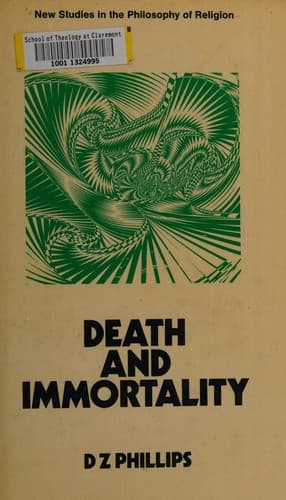
Death and Immortality
الموت والخلود
Mort et immortalité
Editorial summary
This monograph represents a significant contribution to twentieth-century philosophy of religion through its thoroughgoing critique of traditional philosophical approaches to death and immortality. Phillips challenges the dominant tendency in analytic philosophy to treat religious beliefs about eternal life as quasi-scientific hypotheses about post-mortem survival, arguing instead that such an approach fundamentally misunderstands the grammar of religious language.
Central to Phillips' argument is his Wittgensteinian insight that religious discourse about immortality operates according to its own internal logic rather than conforming to empirical or metaphysical standards of verification. He contends that philosophers who debate whether souls survive bodily death or whether resurrection is metaphysically possible have already misconstrued what religious believers mean when they speak of eternal life. For Phillips, talk of immortality in religious contexts is not primarily about temporal duration beyond death but about a qualitative transformation of life in the present—what he terms "participation in the eternal."
The work systematically examines how concepts of death and immortality function within actual religious practices and forms of life. Phillips demonstrates that when believers speak of conquering death through faith or living eternally in God, they are not making predictions about future states but expressing a particular understanding of what makes life meaningful. This approach leads him to reject both traditional defenses of personal immortality and materialist critiques that dismiss religious language as simply false or meaningless.
Phillips particularly targets the philosophical tradition from Plato through Descartes to contemporary dualists who argue for the soul's separability from the body. He argues that such positions rest on conceptual confusions about the nature of personal identity and fail to capture how religious believers actually understand their relationship to death. Similarly, he critiques naturalistic philosophers who assume that exposing the lack of empirical evidence for afterlife beliefs suffices to undermine religious faith.
The monograph's lasting influence stems from its methodological innovation in approaching religious concepts through careful attention to their use in living religious traditions rather than through abstract metaphysical speculation. By shifting focus from questions about what happens after death to questions about how beliefs about immortality shape present existence, Phillips opens new avenues for understanding religious language while avoiding both uncritical acceptance and reductive dismissal of religious claims about eternal life.
Argument formulations engaged
Related works
Phillips, Dewi Zephaniah (1970). Death and Immortality. Macmillan.
@book{death-and-immortality-1970,
  author    = {Phillips, Dewi Zephaniah},
  title     = {Death and Immortality},
  year      = {1970},
  publisher = {Macmillan},
  url       = {https://god-database.com/en/works/death-and-immortality-1970}
}