
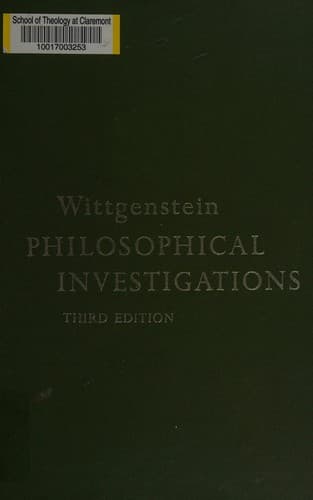
Philosophical Investigations
تحقيقات فلسفية
Investigations philosophiques
Editorial summary
This posthumously published work marks Wittgenstein's radical departure from his earlier logical atomism, offering instead a therapeutic approach to philosophical problems that profoundly impacts discussions about religious language and the concept of God. Rather than constructing systematic theories, Wittgenstein examines how language actually functions in diverse contexts, arguing that meaning derives from use within specific "language-games" embedded in forms of life.
The text's significance for philosophy of religion emerges through its treatment of language, rule-following, and the limits of expression. Wittgenstein contends that philosophical confusions arise when language "goes on holiday" - when words are abstracted from their proper contexts. This insight proves particularly relevant to theological discourse, where terms like "God," "faith," and "soul" often generate conceptual puzzlement when treated as referring to metaphysical entities rather than understood within religious practices.
Through his famous private language argument and discussions of pain, Wittgenstein challenges Cartesian assumptions about the primacy of inner experience, suggesting that even our most intimate sensations require public criteria for meaningful expression. This position undermines both mystical claims to ineffable religious experience and reductionist attempts to explain away religious phenomena as mere psychological states. His treatment of "seeing-as" and aspect perception illuminates how religious believers might genuinely perceive the world differently without making empirical claims that conflict with scientific descriptions.
The work's method - examining particular examples, exposing grammatical confusions, and resisting theoretical systematization - has influenced subsequent approaches to religious language. Philosophers like D.Z. Phillips and Peter Winch have developed Wittgensteinian approaches to religion, arguing that religious utterances function differently from empirical propositions and cannot be evaluated by scientific criteria. Critics, however, worry that this approach insulates religion from rational critique.
Wittgenstein's scattered remarks on religion, including his discussions of Frazer's Golden Bough and comments on religious pictures, suggest that religious language operates expressively rather than descriptively. His notion of "grammar" - the rules governing meaningful discourse within particular domains - implies that debates between theists and atheists often rest on category mistakes, attempting to adjudicate religious claims by inappropriate standards. This perspective neither endorses nor refutes religious belief but rather dissolves certain philosophical problems about God by revealing them as conceptual confusions arising from misunderstanding how religious language functions.
Argument formulations engaged
Related works
Wittgenstein, Ludwig (1953). Philosophical Investigations. Basil Blackwell.
@book{philosophical-investigations-1953,
  author    = {Wittgenstein, Ludwig},
  title     = {Philosophical Investigations},
  year      = {1953},
  publisher = {Basil Blackwell},
  url       = {https://god-database.com/en/works/philosophical-investigations-1953}
}