
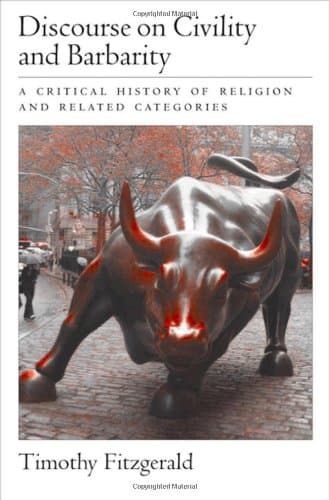
Discourse on Civility and Barbarity
خطاب حول المدنية والبربرية
Discours sur la civilité et la barbarie
Editorial summary
This monograph examines how Western discourses of "religion" and "civility" have functioned as ideological tools in constructing and maintaining colonial and postcolonial power relations. Fitzgerald argues that the modern category of "religion" emerged not as a neutral descriptive term but as a rhetorical device that separates certain practices and beliefs from the supposedly secular domains of politics, economics, and rational discourse. This separation, he contends, has served to position Western liberal democracy as the pinnacle of civilized governance while relegating non-Western worldviews to the status of primitive "religions" requiring modernization.
The work traces how Enlightenment thinkers and colonial administrators deployed concepts of civility and barbarity to create hierarchical distinctions between peoples and cultures. Fitzgerald demonstrates that what counts as "religious" versus "secular" has been determined by Western Protestant assumptions about proper belief and practice, assumptions that have little relevance to many non-Western contexts where no such distinctions traditionally existed. He shows how this categorization process has enabled Western powers to present their own political and economic arrangements as universal rational norms while dismissing alternative social organizations as backward religious systems.
Central to Fitzgerald's analysis is the claim that the modern study of religion itself perpetuates these colonial categories. He argues that religious studies departments, by treating "religion" as a sui generis phenomenon separate from politics and economics, continue to reproduce the very ideological distinctions that justified Western imperialism. The discourse of world religions, with its implicit comparisons to Christianity as the standard, reinforces notions of Western superiority even when intended to promote tolerance and understanding.
The monograph contributes to the God debate by suggesting that Western discussions of theism, atheism, and secularism operate within a culturally specific framework that assumes the validity of the religion-secular divide. Fitzgerald's work implies that debates about God's existence may be less universal than typically assumed, being predicated on Protestant-derived categories that many cultures would not recognize. His critique challenges scholars to reconsider whether the very terms of the God debate reflect parochial Western concerns rather than universal human questions. This deconstructive approach reveals how power relations shape even apparently philosophical discussions about ultimate reality.
Argument formulations engaged
Fitzgerald, Thimothy (2007). Discourse on Civility and Barbarity. Oxford University Press, USA.
@book{discourse-on-civility-and-barbarity-2007,
  author    = {Fitzgerald, Thimothy},
  title     = {Discourse on Civility and Barbarity},
  year      = {2007},
  publisher = {Oxford University Press, USA},
  url       = {https://god-database.com/en/works/discourse-on-civility-and-barbarity-2007}
}