
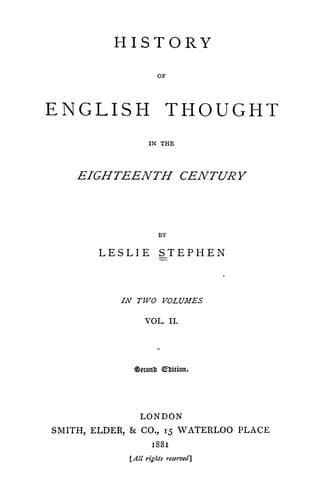
English Thought in the Eighteenth Century (Vol. 2)
الفكر الإنجليزي في القرن الثامن عشر (المجلد 2)
Pensée anglaise au dix-huitième siècle (Vol. 2)
Editorial summary
Leslie Stephen's comprehensive examination of eighteenth-century English intellectual history provides crucial insight into the period's religious and philosophical transformations, particularly regarding the evolving conception of God and religious authority. This second volume continues his systematic analysis of how Enlightenment rationalism reshaped theological discourse in England, focusing on the latter half of the century when deistic and skeptical currents reached their zenith.
Stephen traces the intellectual lineage from early deists through to the more radical skeptics, demonstrating how rational inquiry progressively undermined traditional theological foundations. He examines key figures including David Hume, whose empiricism challenged both natural theology and revealed religion, and Edward Gibbon, whose historical method implicitly questioned providential interpretations of history. The work meticulously documents how these thinkers' arguments against miracles, prophecy, and divine intervention gradually eroded confidence in supernatural explanations.
The author's method combines intellectual biography with systematic philosophical analysis, situating each thinker within broader cultural and political contexts. Stephen demonstrates how the God debate became increasingly intertwined with questions of political authority, social order, and moral philosophy. He reveals how defenders of orthodoxy, including Bishop Butler and William Paley, attempted to reconcile Christian faith with Enlightenment reason, while their opponents pressed rationalist critiques to more radical conclusions.
Particularly significant is Stephen's analysis of how English thought navigated between French materialism and German idealism, maintaining a distinctively empiricist approach to religious questions. He shows how this empiricism led to a gradual shift from explicit atheism toward various forms of agnosticism and religious indifferentism. The work illuminates how intellectual elites increasingly viewed traditional theism as philosophically untenable while remaining cautious about openly embracing atheism due to social and political considerations.
Stephen's contribution lies in demonstrating that the eighteenth-century God debate was not merely abstract philosophical speculation but deeply embedded in concrete social transformations. His analysis reveals how changing views of divine action, religious authority, and natural law reflected and influenced broader shifts in English society. The work remains invaluable for understanding how Enlightenment thought prepared the ground for nineteenth-century agnosticism and secular worldviews, showing the God question as central to the period's intellectual evolution.
Argument formulations engaged
Related works
Stephen, Leslie (1876). English Thought in the Eighteenth Century (Vol. 2). Smith, Elder & Co..
@book{english-thought-in-the-eighteenth-centur,
  author    = {Stephen, Leslie},
  title     = {English Thought in the Eighteenth Century (Vol. 2)},
  year      = {1876},
  publisher = {Smith, Elder & Co.},
  url       = {https://god-database.com/en/works/english-thought-in-the-eighteenth-century-vol-2-1876}
}