
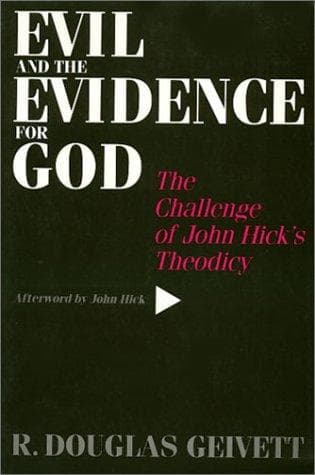
Evil and the Evidence for God: The Challenge of John Hick's Theodicy
الشر والدليل على الله: تحدي ثيوديسية جون هيك
Le mal et les preuves de l'existence de Dieu : Le défi de la théodicée de John Hick
Editorial summary
This monograph presents a systematic critique of John Hick's influential theodicy, examining its philosophical coherence and theological implications for natural theology. Geivett analyzes Hick's soul-making theodicy as articulated primarily in "Evil and the God of Love" (1966), situating it within broader debates about the problem of evil and rational belief in God.
The work begins by reconstructing Hick's theodicy, which reinterprets the traditional Augustinian free-will defense through an Irenaean framework. Geivett explicates how Hick envisions earthly existence as a vale of soul-making where humans develop from biological life toward spiritual maturity through encounters with genuine evil and suffering. Central to this analysis is Hick's concept of epistemic distance—the idea that God remains sufficiently hidden to preserve human freedom while allowing authentic moral and spiritual development.
Geivett's critique operates on multiple levels. Philosophically, he challenges the internal consistency of Hick's system, particularly the tension between divine hiddenness and divine love. He argues that Hick's theodicy generates new problems while attempting to solve traditional ones, especially regarding the distribution and intensity of suffering. The work examines whether soul-making genuinely requires the actual evils present in the world or whether a benevolent deity could achieve the same ends through less devastating means.
Theologically, Geivett scrutinizes Hick's universalism and its relationship to traditional Christian eschatology. He contends that Hick's commitment to universal salvation undermines the significance of earthly moral choices and creates logical difficulties for his soul-making hypothesis. The analysis extends to Hick's religious pluralism, examining how his theodicy connects to his broader theological project of reinterpreting Christian exclusivism.
The monograph's significance lies in its comprehensive engagement with one of the twentieth century's most influential theodicies. Geivett employs the tools of analytic philosophy of religion to demonstrate that Hick's theodicy, despite its initial appeal, faces insurmountable difficulties. He argues that these difficulties not only undermine Hick's specific project but also illuminate broader challenges facing any theodicy that attempts to justify God's permission of evil through appeals to greater goods.
The work contributes to natural theology by defending the possibility of rational theistic belief against Hick's implicit suggestion that traditional theism cannot adequately address the problem of evil without radical theological revision.
Argument formulations engaged
Related works
Geivett, R. Douglas (1993). Evil and the Evidence for God: The Challenge of John Hick's Theodicy. Temple University Press.
@book{evil-and-the-evidence-for-god-the-challe,
  author    = {Geivett, R. Douglas},
  title     = {Evil and the Evidence for God: The Challenge of John Hick's Theodicy},
  year      = {1993},
  publisher = {Temple University Press},
  url       = {https://god-database.com/en/works/evil-and-the-evidence-for-god-the-challenge-of-john-hicks-theodicy-1993}
}