
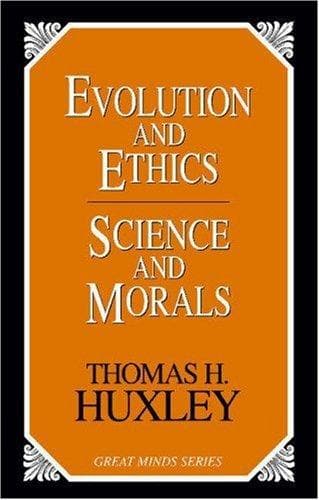
Evolution and Ethics
التطور والأخلاق
Évolution et éthique
Editorial summary
This seminal work examines the relationship between evolutionary processes and ethical principles, challenging prevailing Victorian attempts to derive moral guidance from natural selection. Huxley systematically refutes what he terms the "gladiatorial theory of existence," arguing that the mechanisms driving biological evolution stand in fundamental opposition to the development of human morality and civilization. His analysis represents a crucial intervention in late nineteenth-century debates about naturalistic ethics and the implications of Darwinian theory for human society.
The text develops through careful philosophical argumentation combined with scientific exposition. Huxley demonstrates that while cosmic processes operate through struggle and elimination of the unfit, ethical progress requires humans to combat these very mechanisms. He argues that civilization advances precisely by checking natural selection's harsh operations through compassion, justice, and mutual aid. This position directly confronts Herbert Spencer and other social Darwinists who sought to legitimize competitive individualism through evolutionary theory.
Regarding theological implications, Huxley maintains his characteristic agnostic stance while engaging seriously with religious questions. He rejects both traditional natural theology, which seeks evidence of divine benevolence in nature, and attempts to ground ethics in evolutionary naturalism. Instead, he posits an irreducible tension between cosmic and ethical processes, suggesting that moral imperatives cannot be derived from observing natural phenomena. This argument implicitly challenges both religious and secular foundations for ethics, though Huxley focuses primarily on refuting naturalistic rather than theological ethics.
The work's enduring significance lies in its sophisticated treatment of the naturalistic fallacy and its influence on subsequent discussions about evolutionary ethics. Huxley's sharp distinction between descriptive facts about evolution and prescriptive moral claims establishes important conceptual boundaries that continue to shape contemporary debates. His analysis proves particularly relevant to discussions about sociobiology and evolutionary psychology, which often struggle with similar questions about deriving ought from is.
While Huxley does not directly argue for or against divine existence, his framework suggests that neither nature nor evolution provides adequate grounding for moral values. This creates space for various metaethical positions, from divine command theory to moral constructivism, though Huxley himself remains uncommitted to any particular foundation. His primary contribution remains the negative thesis that evolutionary processes cannot serve as moral guides, forcing subsequent thinkers to seek alternative grounds for ethical principles.
Argument formulations engaged
Related works
Huxley, Thomas Henry (1893). Evolution and Ethics.
@book{evolution-and-ethics-1893,
  author    = {Huxley, Thomas Henry},
  title     = {Evolution and Ethics},
  year      = {1893},
  url       = {https://god-database.com/en/works/evolution-and-ethics-1893}
}