
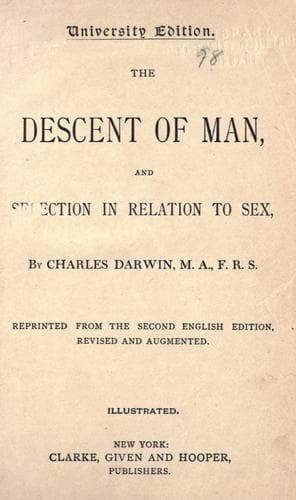
The Descent of Man
أصل الإنسان
La Filiation de l'homme
Human beings, including their moral faculties, social instincts, and religious sentiments, are fully explicable as products of natural selection and common descent, without recourse to supernatural design.
Editorial summary
Charles Darwin's The Descent of Man extends evolutionary theory to human origins, fundamentally challenging traditional theological anthropology and the argument from design. While primarily a scientific treatise, the work carries profound implications for debates about divine action, human nature, and the relationship between scientific and religious explanations of human existence.
Darwin methodically applies natural selection to explain human physical and mental characteristics, arguing that humans descended from animal ancestors through gradual modification. This empirical approach directly confronts the prevailing view of special creation, wherein humans possess a divinely endowed soul distinguishing them categorically from animals. By demonstrating continuity between human and animal cognition, morality, and emotion, Darwin undermines the anthropocentric design argument that sees human faculties as evidence of divine intention.
The work engages significantly with naturalistic explanations of religion itself. Darwin traces religious belief to evolutionary origins, suggesting that the tendency to attribute agency to natural phenomena, combined with dreams and imagination, led primitive humans to develop spiritual concepts. He argues that religious feelings emerge from social instincts and cognitive capacities that evolved for survival advantage, not from divine revelation. This naturalistic account of religion's origins anticipates later evolutionary approaches to religious phenomena.
Darwin's careful empirical methodology reflects the scientific standards of Victorian Britain while navigating the period's religious sensitivities. He acknowledges the work's implications for natural theology but maintains a largely descriptive stance, focusing on evidence rather than explicit theological argumentation. The text reveals Darwin's awareness that his theory challenges William Paley's design argument and the biblical account of human origins, yet he avoids direct confrontation with religious doctrine.
The Descent of Man's significance for the God debate lies in its comprehensive naturalistic explanation for human characteristics previously attributed to divine design or intervention. By demonstrating that natural processes could account for human physical form, mental capacities, moral sense, and even religious inclinations, Darwin's work fundamentally altered the intellectual landscape. It forced subsequent thinkers to reconsider the relationship between scientific explanation and religious belief, establishing evolution as an unavoidable consideration in discussions of human nature, divine action, and the origins of religious consciousness. The work remains foundational for understanding how empirical science challenges traditional theological anthropology.
Structured analysis
Argument formulations engaged
Related works
Darwin, Charles (1871). The Descent of Man. The University of Adelaide Library.
@book{the-descent-of-man,
  author    = {Darwin, Charles},
  title     = {The Descent of Man},
  year      = {1871},
  publisher = {The University of Adelaide Library},
  url       = {https://god-database.com/en/works/the-descent-of-man}
}