
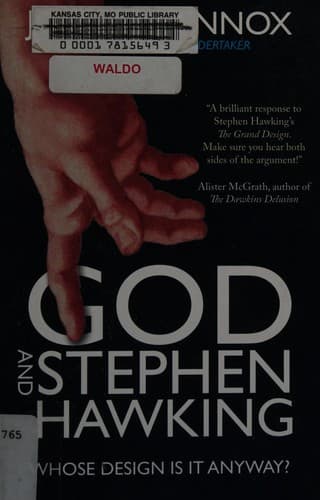
God and Stephen Hawking.. Whose Design Is It Anyway
الله وستيفن هوكينج.. لمن التصميم إذن؟
Dieu et Stephen Hawking.. De qui est donc ce dessein ?
Hawking-style appeals to laws or self-contained cosmology do not remove the deeper question of why there is a law-governed universe at all.
Editorial summary
John Lennox's "God and Stephen Hawking: Whose Design Is It Anyway?" presents a systematic Christian philosophical response to Stephen Hawking's atheistic cosmology as articulated in "The Grand Design" (2010). Writing from within the analytic tradition, Lennox, a mathematician and philosopher of science at Oxford University, directly challenges Hawking's claim that the universe's existence can be fully explained through physical laws without recourse to divine agency.
The work employs an apologetic synthesis methodology, drawing together philosophical argumentation, scientific analysis, and theological reflection to counter Hawking's naturalistic framework. Lennox structures his critique around three central contentions: first, that Hawking commits a category error by conflating physical laws with causal agency; second, that the fine-tuning of universal constants points toward design rather than necessity; and third, that Hawking's multiverse hypothesis fails to eliminate the need for ultimate explanation.
Regarding the cosmological argument, Lennox contends that Hawking's appeal to gravity as the mechanism for spontaneous creation from nothing involves conceptual confusion. Laws of nature, he argues, describe patterns but do not possess causal powers themselves. The existence of gravity presupposes the existence of matter and space-time, rendering Hawking's account circular. Lennox emphasizes that explaining how the universe operates differs fundamentally from explaining why it exists at all.
The fine-tuning argument receives extensive treatment as Lennox examines the extraordinary precision required for life-permitting constants. He critiques Hawking's M-theory solution, arguing that invoking multiple universes merely pushes the design question back rather than resolving it. The meta-laws governing any multiverse would themselves require explanation, suggesting that naturalistic accounts inevitably face an explanatory regress.
Lennox's contribution to the God debate lies in demonstrating how contemporary physics, properly interpreted, remains compatible with theistic belief. His work challenges the widespread assumption that scientific advancement necessarily erodes grounds for religious conviction. By engaging directly with one of physics' most prominent voices, Lennox provides sophisticated philosophical analysis accessible to educated general readers while maintaining academic rigor.
The monograph's significance extends beyond its specific rebuttals to exemplify how analytic philosophy of religion can engage constructively with contemporary scientific cosmology. Lennox models how theistic thinkers can acknowledge scientific findings while resisting reductionist interpretations that exclude divine action from rational consideration.
Structured analysis
Argument formulations engaged
Related works
Lennox, John (2011). God and Stephen Hawking.. Whose Design Is It Anyway.
@book{god-and-stephen-hawking-whose-design-is-,
  author    = {Lennox, John},
  title     = {God and Stephen Hawking.. Whose Design Is It Anyway},
  year      = {2011},
  url       = {https://god-database.com/en/works/god-and-stephen-hawking-whose-design-is-it-anyway}
}