
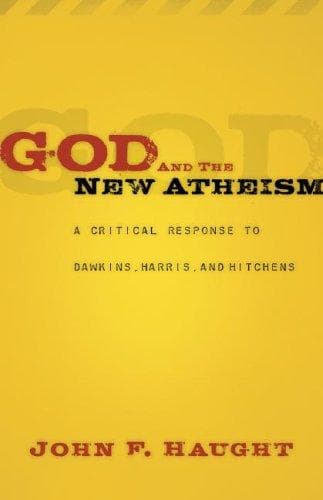
God and the New Atheism.. A Critical response to Dawkins, Harris and Hitchens
الله والإلحاد الجديد.. رد نقدي على دوكينز وهاريس وهيتشنز
Dieu et le nouvel athéisme.. Une réponse critique à Dawkins, Harris et Hitchens
The New Atheism of Dawkins, Harris, and Hitchens fails as serious intellectual engagement with religion because it misrepresents the depth of theological tradition and reduces faith to its most superficial forms.
Editorial summary
In this monograph, John F. Haught presents a systematic theological response to the New Atheism movement, particularly targeting the arguments advanced by Richard Dawkins, Sam Harris, and Christopher Hitchens. Writing from within the Christian-analytic tradition, Haught contends that these prominent atheist critics fundamentally misunderstand both the nature of religious faith and the intellectual sophistication of theological reflection. His project represents an apologetic synthesis that seeks to demonstrate how the New Atheists' critiques rest on philosophically naive assumptions about God, science, and human existence.
Haught's central argument proceeds on multiple fronts. First, he challenges what he perceives as the New Atheists' crude scientism—their reduction of all valid knowledge to empirical scientific method. He argues that Dawkins, Harris, and Hitchens operate with an impoverished epistemology that cannot adequately address questions of meaning, value, and ultimate purpose. Second, Haught maintains that the New Atheists attack a caricature of religious belief, conflating fundamentalist literalism with the broader theological tradition. He particularly criticizes their failure to engage with process theology, evolutionary theology, and other sophisticated contemporary approaches to the God question.
The work engages extensively with design arguments, responding to Dawkins' critique of biological design by articulating a theology of evolution that sees divine creativity working through rather than against natural processes. Haught develops what he calls a "theology of depth," arguing that God operates not as a designer imposing order from above but as the ground of being drawing creation toward greater complexity and consciousness. This approach allows him to accept evolutionary science while maintaining that the universe exhibits purposiveness at a deeper level than mechanistic explanation can capture.
Haught's cumulative case for theism emphasizes three dimensions the New Atheists allegedly ignore: the irreducibility of subjective experience, the reality of moral obligation, and humanity's persistent orientation toward transcendence. He argues that scientific materialism cannot account for these phenomena without explanatory gaps or reductionism. The work's significance lies in its attempt to shift the debate beyond simplistic science-versus-religion dichotomies, proposing instead a layered understanding of reality where scientific and theological explanations operate at different but compatible levels. While critics might question whether Haught fully addresses the New Atheists' empirical challenges, his monograph represents a substantive effort to demonstrate that contemporary theism can engage scientific rationality without sacrificing intellectual integrity.
Structured analysis
Structure of the work
Argument formulations engaged
Related works
Haught, John F. (2008). God and the New Atheism.. A Critical response to Dawkins, Harris and Hitchens. Westminster John Knox Press.
@book{god-and-the-new-atheism-a-critical-respo,
  author    = {Haught, John F.},
  title     = {God and the New Atheism.. A Critical response to Dawkins, Harris and Hitchens},
  year      = {2008},
  publisher = {Westminster John Knox Press},
  url       = {https://god-database.com/en/works/god-and-the-new-atheism-a-critical-response-to-dawkins-harris-and-hitchens}
}