
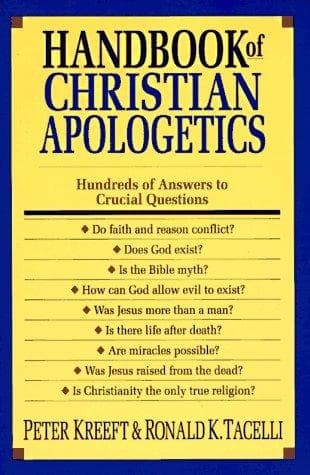
Handbook of Christian Apologetics
دليل الدفاع عن المسيحية
Manuel d'apologétique chrétienne
Christian faith is rationally defensible on philosophical, historical, and moral grounds, and every major objection raised by skeptics, atheists, and relativists can be answered with rigorous argument.
Editorial summary
This comprehensive apologetic manual presents systematic philosophical defenses of Christian theism through rational argumentation. Peter Kreeft, working within the Christian analytic tradition, constructs a methodical case for God's existence and the truth claims of Christianity by engaging multiple classical argument families while addressing contemporary objections.
The work begins by establishing the proper relationship between faith and reason, arguing that Christian belief rests on rational foundations rather than blind acceptance. Kreeft then develops variations of the cosmological argument, particularly emphasizing the argument from contingency and the impossibility of infinite regress. His treatment connects Thomas Aquinas's Five Ways with modern philosophical discussions, demonstrating how these medieval insights remain philosophically viable against materialist explanations of cosmic origins.
Regarding design arguments, Kreeft moves beyond simplistic watchmaker analogies to present sophisticated versions addressing fine-tuning in physics and the intelligibility of natural laws. He engages contemporary scientific findings while distinguishing between methodological naturalism as a research principle and philosophical naturalism as a worldview. The moral argument receives extensive treatment, with Kreeft arguing that objective moral values and duties require a transcendent foundation. He directly confronts relativist and evolutionary debunking arguments, maintaining that moral experience points toward divine grounding.
The prophecy argument occupies a significant portion, where Kreeft examines biblical predictions and their historical fulfillments as evidence for divine revelation. This section integrates historical-critical scholarship while defending the reliability of prophetic texts against skeptical readings. Throughout, Kreeft addresses standard objections including the problem of evil, religious diversity, and alleged conflicts between science and faith.
The handbook's methodology combines rigorous philosophical analysis with accessibility, making technical arguments comprehensible without sacrificing intellectual depth. Kreeft engages seriously with atheistic philosophers like Mackie and Nielsen while drawing on the broader Christian intellectual tradition from Augustine through contemporary thinkers like Plantinga and Swinburne. The work serves both as an introduction for students and a reference for those seeking systematic responses to challenges against theistic belief.
This volume contributes to contemporary philosophy of religion by demonstrating how classical theistic arguments can be reformulated to address modern concerns. While operating from committed Christian premises, Kreeft maintains philosophical rigor in presenting arguments that appeal to natural reason rather than revealed authority, thereby engaging secular philosophical discourse on its own terms.
Argument formulations engaged
Related works
Kreeft, Peter Handbook of Christian Apologetics.
@book{handbook-of-christian-apologetics,
  author    = {Kreeft, Peter},
  title     = {Handbook of Christian Apologetics},
  year      = {n.d.},
  url       = {https://god-database.com/en/works/handbook-of-christian-apologetics}
}