
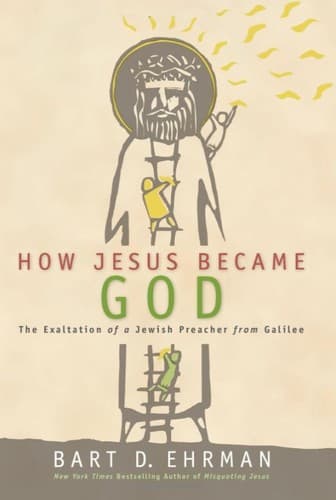
How Jesus Became God
كيف أصبح يسوع إلهاً
Comment Jésus est devenu Dieu
Editorial summary
Bart Ehrman's How Jesus Became God examines the historical transformation of Jesus from a Jewish apocalyptic preacher into the divine figure worshipped by Christians. The work contributes to debates about the God of Christianity by arguing that Jesus' divinity represents a human construction rather than a historical reality, challenging traditional Christian claims about the incarnation and the nature of God.
Ehrman employs historical-critical methodology to trace how early Christians progressively elevated Jesus' status. He argues that Jesus himself did not claim to be God but rather saw himself as an apocalyptic prophet announcing God's coming kingdom. The belief in Jesus' divinity, Ehrman contends, emerged only after his crucifixion, when followers became convinced of his resurrection. This experience led them to reinterpret Jesus' significance using available Jewish and Greco-Roman categories of divine beings.
The work systematically examines how different Christian communities developed varying christologies. Ehrman demonstrates that earliest Christians viewed Jesus as a human exalted to divine status at his resurrection, while later Christians pushed his divinity back to his baptism, then to his birth, and finally to his pre-existence. He traces this development through New Testament texts, showing how Paul's letters reflect an early "exaltation Christology" while John's Gospel represents a later "incarnation Christology."
Ehrman positions his argument against both conservative Christian scholars who maintain that Jesus claimed divinity and that early Christianity possessed a unified high Christology from the beginning. He challenges scholars like Richard Bauckham and Larry Hurtado who argue for early Christian monotheism accommodating Jesus' worship. Instead, Ehrman contends that early Christianity's theological development reflects typical patterns of religious evolution rather than divine revelation.
The work's significance lies in its accessible presentation of critical scholarship on Christian origins to general audiences. By demonstrating the human processes behind Christianity's central theological claim, Ehrman implicitly challenges theistic assumptions about divine revelation and incarnation. His historical reconstruction suggests that the Christian God-concept emerged through cultural evolution rather than supernatural disclosure. The book thus contributes to naturalistic explanations of religious phenomena, supporting broader skeptical approaches to theistic claims while acknowledging the historical importance of belief in Jesus' divinity for Western civilization's development.
Argument formulations engaged
Related works
Ehrman, Bart (2014). How Jesus Became God. HarperOne.
@book{how-jesus-became-god-2014,
  author    = {Ehrman, Bart},
  title     = {How Jesus Became God},
  year      = {2014},
  publisher = {HarperOne},
  url       = {https://god-database.com/en/works/how-jesus-became-god-2014}
}