
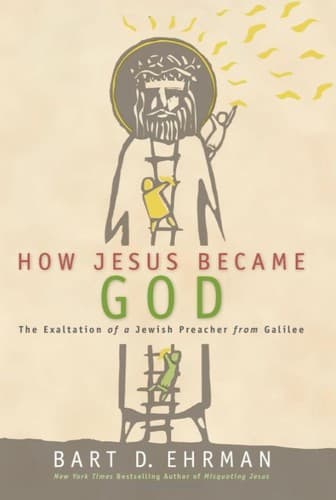
How Jesus Became God.. The Exaltation of a Jewish Preacher from Galilee
كيف أصبح يسوع إلهاً.. تمجيد واعظ يهودي من الجليل
Comment Jésus est devenu Dieu.. L'exaltation d'un prédicateur juif de Galilée
The divinity of Jesus was not an original claim made by Jesus himself but a gradually developing theological construction shaped by early Christian communities in the decades following his death.
Editorial summary
Bart Ehrman's "How Jesus Became God: The Exaltation of a Jewish Preacher from Galilee" presents a historical-critical examination of early Christian beliefs about Jesus's divine status, arguing that the conception of Jesus as God emerged through a gradual process of theological development rather than from Jesus's own self-understanding or the immediate convictions of his first followers. Ehrman contends that Jesus himself, operating within a Jewish apocalyptic framework, understood himself as a prophet announcing God's imminent kingdom rather than as a divine being deserving worship.
The work traces what Ehrman characterizes as an evolutionary trajectory in Christological thinking. Beginning with the earliest followers who believed Jesus had been exalted to divine status through his resurrection, the study documents progressive stages of "christological inflation" - from Jesus being adopted as God's son at his resurrection, to his pre-existence as a divine being, and ultimately to the orthodox doctrine of his eternal divinity. Ehrman employs comparative analysis of Greco-Roman and Jewish concepts of divine beings, arguing that early Christians drew upon existing categories of exalted humans and divine intermediaries to conceptualize Jesus's status.
Central to Ehrman's methodology is his stratification of New Testament sources, identifying what he considers earlier and later theological layers. He argues that the highest Christological claims appear in the latest texts, while earlier sources reflect more modest assessments of Jesus's nature. This developmental model directly challenges traditional Christian claims about prophetic fulfillment, suggesting that messianic and divine attributes were retrospectively applied to Jesus rather than recognized during his lifetime.
The work engages significantly with prophecy arguments, though from a skeptical stance. Ehrman maintains that early Christians creatively reinterpreted Hebrew scriptures to support their evolving beliefs about Jesus, rather than recognizing genuine prophetic fulfillments. He examines how texts originally unrelated to messianic expectations were transformed through Christian exegesis into predictions of Jesus's divinity.
Ehrman's contribution to the God debate lies in his naturalistic account of Christianity's central theological claim. By providing a purely historical explanation for belief in Jesus's divinity, the work implicitly challenges supernatural interpretations of Christian origins. His analysis suggests that the development of high Christology requires no divine intervention but can be explained through ordinary processes of religious evolution within specific cultural contexts.
Structured analysis
Argument formulations engaged
Related works
Ehrman, Bart D. (2014). How Jesus Became God.. The Exaltation of a Jewish Preacher from Galilee. HarperOne.
@book{how-jesus-became-god-the-exaltation-of-a,
  author    = {Ehrman, Bart D.},
  title     = {How Jesus Became God.. The Exaltation of a Jewish Preacher from Galilee},
  year      = {2014},
  publisher = {HarperOne},
  url       = {https://god-database.com/en/works/how-jesus-became-god-the-exaltation-of-a-jewish-preacher-from-galilee}
}