
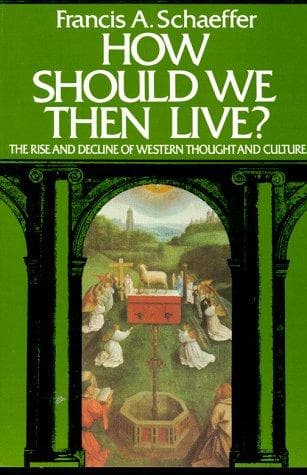
How Should We Then Live?
كيف يجب أن نعيش إذن؟
Comment devons-nous alors vivre ?
Editorial summary
This influential work presents Francis Schaeffer's comprehensive analysis of Western civilization's intellectual and spiritual decline, arguing that the abandonment of biblical Christianity as society's foundation has led to moral relativism, cultural fragmentation, and the loss of human dignity. Schaeffer traces the development of Western thought from ancient Rome through the 20th century, demonstrating how the shift from a God-centered worldview to secular humanism has produced what he terms the modern predicament of meaninglessness and despair.
The work employs a sweeping historical methodology, examining art, philosophy, science, and politics to illustrate how worldview assumptions shape cultural expressions and social structures. Schaeffer contends that the Reformation's emphasis on biblical authority provided the intellectual foundation for human rights, scientific inquiry, and political freedom. He argues that when Enlightenment thinkers severed reason from divine revelation, they initiated a trajectory toward nihilism that culminated in 20th-century totalitarianism and existential despair.
Central to Schaeffer's argument is his critique of what he calls the line of despair, where modern thought, having rejected absolute truth grounded in God's existence and nature, cannot provide adequate answers to fundamental questions about meaning, morality, and human value. He particularly challenges secular humanism's inability to justify human dignity and rights without transcendent foundations, arguing that attempts to maintain Christian ethics while denying Christian metaphysics prove intellectually inconsistent and culturally unsustainable.
The work engages critically with existentialism, liberal theology, and naturalistic philosophy, positioning biblical theism as the only worldview capable of providing coherent answers to modern dilemmas. Schaeffer warns that Western civilization faces either totalitarian manipulation or anarchic fragmentation unless it returns to its Christian foundations. His prescriptive vision calls for cultural renewal through the recovery of biblical truth as the basis for all areas of life and thought.
The monograph's significance lies in its accessible integration of apologetics, cultural criticism, and historical analysis, influencing evangelical intellectual engagement with contemporary culture. Schaeffer's argument that ideas have consequences and that theological commitments shape civilizational trajectories continues to inform debates about secularization, public philosophy, and the relationship between religious belief and cultural vitality. His work remains a touchstone for those arguing that theistic foundations are necessary for human flourishing and social cohesion.
Argument formulations engaged
Schaeffer, Francis (1976). How Should We Then Live?. Crossway.
@book{how-should-we-then-live-1976,
  author    = {Schaeffer, Francis},
  title     = {How Should We Then Live?},
  year      = {1976},
  publisher = {Crossway},
  url       = {https://god-database.com/en/works/how-should-we-then-live-1976}
}