
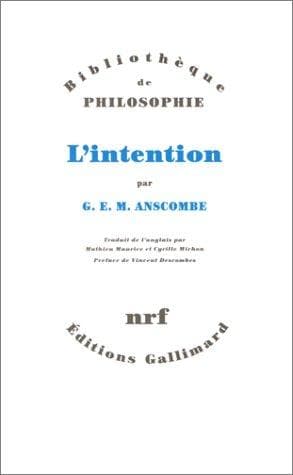
Intention
القصد
Editorial summary
This monograph represents a foundational contribution to action theory and philosophy of mind, with significant implications for theological discussions of divine action and human agency. Anscombe develops a novel account of intentional action that challenges prevailing causal theories while establishing a framework that proves influential for both secular and religious philosophical traditions.
The work distinguishes between three uses of "intention": intention for the future, intention with which someone acts, and intentional action. Anscombe argues that intentional actions are those to which a certain sense of the question "Why?" applies—specifically, questions seeking reasons rather than mere causes. This approach rejects the view that intentions are mental states or events that cause bodily movements, proposing instead that intention is intrinsic to certain descriptions of action.
Central to her argument is the concept of practical knowledge—knowledge without observation that agents possess of their own intentional actions. This non-observational knowledge differs fundamentally from speculative knowledge, as it represents knowledge of what one is doing rather than knowledge derived from evidence. The distinction proves crucial for understanding human agency as irreducible to mere physical causation.
The monograph's treatment of action under different descriptions demonstrates that the same physical movement can be intentional under one description but not under another. This insight bears on theological questions about divine providence and human freedom, as it suggests that human actions can simultaneously be free under human descriptions and providentially guided under divine descriptions.
Anscombe's critique of consequentialism emerges from her action theory, arguing that the concept of intention makes certain acts absolutely prohibitable regardless of consequences. This position aligns with traditional religious ethics while providing philosophical grounding independent of explicit theological commitments.
The work engages critically with modern philosophy's tendency to model human action on mechanical causation, drawing on Aristotle and Aquinas to recover a richer understanding of practical reason. While not explicitly theological, the framework accommodates religious conceptions of human beings as rational agents created in the divine image, capable of genuine agency rather than mere mechanical response to stimuli.
The monograph's influence extends across philosophy of action, ethics, and philosophy of religion, providing conceptual tools for discussing divine action, moral responsibility, and the relationship between reasons and causes in human behavior.
Argument formulations engaged
Anscombe, Elizabeth (1957). Intention. Harvard University Press.
@book{intention-1957,
  author    = {Anscombe, Elizabeth},
  title     = {Intention},
  year      = {1957},
  publisher = {Harvard University Press},
  url       = {https://god-database.com/en/works/intention-1957}
}