
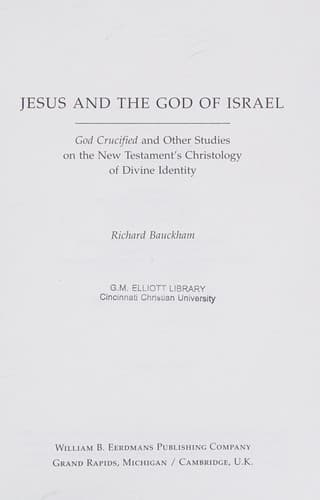
Jesus and the God of Israel: God Crucified and Other Studies on the New Testament's Christology of Divine Identity
يسوع وإله إسرائيل: الله المصلوب ودراسات أخرى حول كريستولوجيا الهوية الإلهية في العهد الجديد
Jésus et le Dieu d'Israël : Dieu crucifié et autres études sur la christologie de l'identité divine du Nouveau Testament
Editorial summary
This monograph presents Richard Bauckham's influential thesis that early Christian texts depict Jesus as included within the unique divine identity of Israel's God. Bauckham challenges prevailing scholarly paradigms that explain New Testament Christology through categories of intermediary figures or gradual divinization. Instead, he argues that the earliest Christians made the radical claim that Jesus shares in the very identity of the one God of Jewish monotheism.
Central to Bauckham's argument is his concept of "divine identity" as the proper framework for understanding Jewish monotheism and early Christology. He contends that Second Temple Judaism distinguished God from all other reality not through metaphysical attributes but through unique identifying characteristics: God alone created all things, rules over all, and will achieve eschatological sovereignty. The New Testament writers, Bauckham demonstrates, systematically include Jesus in precisely these activities that constitute divine identity. Jesus participates in creation, shares God's throne, receives worship, and bears the divine name.
The work engages critically with two dominant scholarly approaches. Against those who see early Christology as emerging through Hellenistic influence or evolutionary development, Bauckham argues for a "Christology of divine identity" present from Christianity's inception. He also challenges scholars who explain Jesus's exalted status through Jewish intermediary figures like Wisdom or principal angels, showing how these parallels fail to account for the specific ways Jesus is included in God's unique sovereignty and worship.
Bauckham's methodology combines careful exegesis of New Testament texts with comprehensive analysis of Second Temple Jewish literature. He demonstrates how Jewish monotheistic categories shaped the earliest Christian claims about Jesus, while showing how those claims represented a creative mutation within Jewish monotheism rather than its abandonment. His treatment spans multiple New Testament writings, with particular attention to how throne imagery, divine names, and worship practices function as markers of divine identity.
This work significantly impacts contemporary debates about the origins of belief in Jesus's divinity and the relationship between Christianity and Jewish monotheism. By arguing that the highest Christology appears at Christianity's origins rather than through later development, Bauckham's thesis bears important implications for understanding religious innovation, the formation of Christian doctrine, and the theological interpretation of New Testament texts. His divine identity framework has become a major reference point in subsequent scholarship on early Christology.
Argument formulations engaged
Related works
Bauckham, Richard (2008). Jesus and the God of Israel: God Crucified and Other Studies on the New Testament's Christology of Divine Identity. Eerdmans.
@book{jesus-and-the-god-of-israel-god-crucifie,
  author    = {Bauckham, Richard},
  title     = {Jesus and the God of Israel: God Crucified and Other Studies on the New Testament's Christology of Divine Identity},
  year      = {2008},
  publisher = {Eerdmans},
  url       = {https://god-database.com/en/works/jesus-and-the-god-of-israel-god-crucified-and-other-studies-on-the-new-testaments-christology-of-divine-identity-2008}
}