
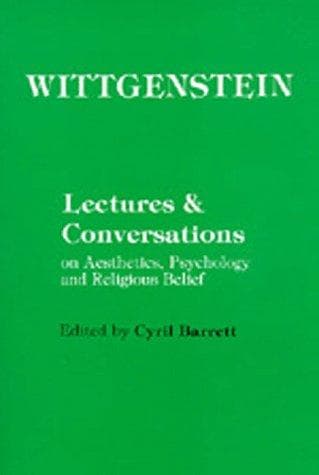
Lectures and Conversations on Aesthetics, Psychology and Religious Belief
محاضرات ومحادثات حول الجماليات وعلم النفس والمعتقد الديني
Conférences et conversations sur l'esthétique, la psychologie et la croyance religieuse
Editorial summary
This posthumous collection presents Wittgenstein's later thoughts on religious belief, offering a distinctive philosophical approach that sidesteps traditional debates about God's existence. Compiled from student notes of lectures given at Cambridge between 1938 and 1946, the work reveals Wittgenstein's radical reconceptualization of religious language and belief as fundamentally different from empirical or theoretical propositions.
The text's most significant contribution to philosophy of religion lies in its grammatical investigation of religious discourse. Wittgenstein argues that religious utterances operate according to different rules than factual statements. When someone says "God exists" or "there will be a Last Judgment," they are not making claims that can be verified or falsified through evidence. Rather, these statements express what Wittgenstein calls "pictures" that regulate believers' entire worldview and conduct. This approach dissolves traditional philosophical puzzles about religious belief by showing them to rest on category mistakes.
The lectures demonstrate how religious and non-religious people do not simply disagree about facts but inhabit different conceptual frameworks. Wittgenstein illustrates this through examples: a believer who orients their life around the Last Judgment and a non-believer who does not are not contradicting each other in the way that two scientists might dispute experimental results. They are playing different language games with different criteria for sense and nonsense.
This analysis challenges both traditional natural theology, which seeks to prove God's existence through rational argument, and its critics who demand empirical evidence for religious claims. By examining how religious language actually functions in believers' lives, Wittgenstein undermines the assumption shared by both theists and atheists that religious statements are proto-scientific hypotheses. His method shows particular influence from his engineering background and his reading of Kierkegaard, combining precise conceptual analysis with attention to the existential dimension of faith.
The work's enduring importance lies in its reframing of philosophical questions about God. Rather than asking whether religious beliefs are true or false, Wittgenstein investigates what it means to hold such beliefs and how they differ grammatically from other forms of discourse. This approach has profoundly influenced subsequent philosophy of religion, inspiring both Wittgensteinian fideism and more nuanced analyses of religious language. The text remains essential for understanding how linguistic philosophy can illuminate religious phenomena without reducing them to empirical or metaphysical claims.
Argument formulations engaged
Related works
Wittgenstein, Ludwig (1966). Lectures and Conversations on Aesthetics, Psychology and Religious Belief. Basil Blackwell.
@book{lectures-and-conversations-on-aesthetics,
  author    = {Wittgenstein, Ludwig},
  title     = {Lectures and Conversations on Aesthetics, Psychology and Religious Belief},
  year      = {1966},
  publisher = {Basil Blackwell},
  url       = {https://god-database.com/en/works/lectures-and-conversations-on-aesthetics-psychology-and-religious-belief-1966}
}