
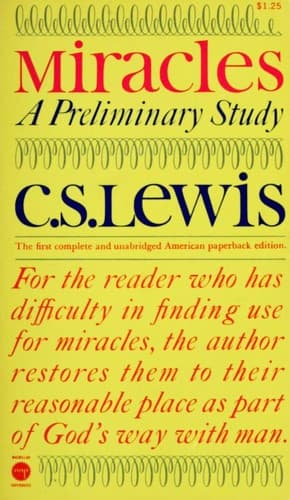
Miracles
المعجزات
Les Miracles
Miracles are genuinely possible and historically credible because naturalism is self-refuting and the existence of a supernatural God who created nature entails that He can act within it.
Editorial summary
C.S. Lewis's "Miracles" presents a sustained philosophical defense of the possibility and actuality of miracles within a theistic framework, directly challenging the naturalistic worldview that dominated mid-20th century intellectual culture. The work systematically dismantles what Lewis terms the "naturalist" position—the view that the material universe constitutes the whole of reality and operates according to fixed laws admitting no supernatural intervention.
Lewis begins by establishing a crucial distinction between naturalism and supernaturalism, arguing that the very possibility of rational thought undermines strict naturalism. If human reason emerged solely from non-rational natural processes, Lewis contends, there would be no grounds for trusting its deliverances—including the belief in naturalism itself. This self-refutation argument forms the foundation for his subsequent defense of miracles as divine interventions in the natural order.
The monograph engages critically with Humean skepticism about miracles, particularly the claim that testimony to miraculous events should always be rejected in favor of natural explanations. Lewis argues that this position begs the question by assuming what it purports to prove—namely, that miracles are impossible. He demonstrates that the plausibility of miracle reports depends entirely on one's prior philosophical commitments about the nature of reality. If a personal God exists, miracles become not only possible but arguably probable at certain junctures of history.
Lewis develops a sophisticated account of how miracles relate to natural law, rejecting both the view that miracles "violate" such laws and the modernist reduction of miracles to subjective religious experiences. Instead, he proposes that miracles represent instances where God introduces new events into the natural system, which then follow natural laws once introduced. This preserves both the integrity of natural order and the possibility of divine action.
The work's philosophical rigor distinguishes it from merely devotional treatments of miracles. Lewis engages seriously with scientific objections while avoiding the pitfall of making theism dependent on gaps in scientific knowledge. His argument that naturalism cannot account for human rationality anticipates later developments in philosophy of mind, while his treatment of testimony and probability remains relevant to contemporary epistemology of religious belief. "Miracles" thus stands as a significant contribution to natural theology and religious epistemology within the analytic tradition.
Argument formulations engaged
Related works
Lewis, C.S. Miracles.
@book{miracles,
  author    = {Lewis, C.S.},
  title     = {Miracles},
  year      = {n.d.},
  url       = {https://god-database.com/en/works/miracles}
}