
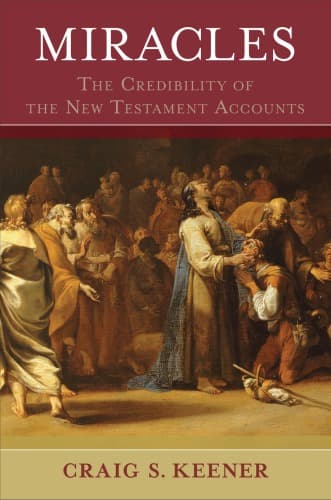
Miracles: The Credibility of the New Testament Accounts
المعجزات: مصداقية روايات العهد الجديد
Miracles : La crédibilité des récits du Nouveau Testament
Editorial summary
Craig Keener's two-volume monograph represents the most comprehensive scholarly examination of miracle accounts in contemporary historical Jesus research. The work directly challenges the methodological naturalism that dominates biblical criticism, arguing that historians' a priori exclusion of supernatural causation reflects philosophical bias rather than sound historical method. Keener contends that miracle reports in the New Testament deserve serious historical consideration alongside other ancient testimonies.
The study employs a cross-cultural comparative approach, documenting thousands of contemporary miracle claims from Africa, Asia, and Latin America. Keener argues that the ubiquity of such reports across cultures suggests that historians cannot simply dismiss ancient miracle accounts as products of pre-scientific worldviews. He maintains that while historians cannot prove divine causation, they can establish that eyewitnesses sincerely believed they experienced supernatural events, making complete dismissal of such testimonies historically irresponsible.
Keener engages extensively with David Hume's influential argument against miracles, contending that Hume's position rests on circular reasoning and ethnocentric assumptions about non-Western testimony. The work critiques both radical skeptics who reject all miracle claims and fundamentalists who accept them uncritically, advocating instead for careful historical evaluation of individual accounts. Keener argues that the Gospel miracle narratives exhibit features consistent with eyewitness testimony rather than purely legendary development.
The monograph's significance extends beyond biblical studies to philosophy of history and religious epistemology. By challenging the assumption that historical method requires methodological atheism, Keener reopens debates about the relationship between faith commitments and academic inquiry. His extensive documentation of contemporary miracle reports forces engagement with the question of whether modern secular historiography arbitrarily excludes certain types of human experience from legitimate historical investigation.
While Keener stops short of claiming historical proof for any specific miracle, he argues that the persistence and distribution of miracle testimonies across cultures constitute data requiring explanation. The work thus shifts the burden of proof, suggesting that those who categorically dismiss all miracle reports must account for the widespread human tendency to report such experiences. This methodological intervention has sparked significant debate about the boundaries of historical investigation and the role of worldview commitments in shaping scholarly method.
Argument formulations engaged
Related works
Keener, Craig (2011). Miracles: The Credibility of the New Testament Accounts. Baker Academic.
@book{miracles-the-credibility-of-the-new-test,
  author    = {Keener, Craig},
  title     = {Miracles: The Credibility of the New Testament Accounts},
  year      = {2011},
  publisher = {Baker Academic},
  url       = {https://god-database.com/en/works/miracles-the-credibility-of-the-new-testament-accounts-2011}
}