
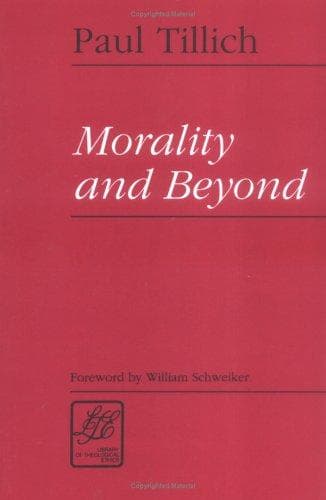
Morality and Beyond
الأخلاق وما وراءها
Moralité et Au-delà
Editorial summary
Paul Tillich's "Morality and Beyond" presents a sophisticated theological analysis that seeks to transcend conventional ethical frameworks by grounding morality in what he terms "the dimension of the ultimate." Published in 1963, this work represents a mature articulation of Tillich's existentialist theology, demonstrating how moral experience points beyond itself to religious depth. The monograph engages critically with both secular ethical philosophy and traditional religious moralism, offering instead a vision where authentic morality emerges from humanity's encounter with the divine ground of being.
Tillich argues that conventional morality, whether religious or secular, suffers from a fundamental limitation: it operates within the subject-object structure of finite existence without addressing the ultimate concern that underlies all ethical striving. He contends that moral laws and principles, while necessary for social order, become demonic when absolutized. This critique extends equally to religious legalism and secular autonomous ethics. The work develops through phenomenological analysis of moral experience, revealing how conscience, guilt, and moral imperative all point toward a transcendent dimension that cannot be captured by ethical codes alone.
The theological core of Tillich's argument rests on his conception of God not as a supreme being who issues commands, but as Being-itself, the ground and power of all existence. Morality finds its true foundation not in divine decrees but in the courage to be, which emerges from participation in this ultimate reality. This position allows Tillich to navigate between authoritarian heteronomy and empty autonomy, proposing instead a "theonomy" where human moral creativity expresses its grounding in the divine.
The monograph engages substantively with Kantian ethics, existentialist philosophy, and Protestant theological tradition, particularly responding to Karl Barth's divine command theory and Rudolf Bultmann's demythologization project. Tillich's method combines existential analysis with systematic theology, employing his characteristic correlation approach to demonstrate how cultural questions about morality find their answers in religious symbols properly interpreted.
This work's significance lies in its attempt to preserve both the seriousness of ethical obligation and the transformative power of religious experience. By arguing that morality points beyond itself to its religious depth, Tillich provides a framework for understanding how ethical life relates to ultimate concern without reducing either to the other. His analysis remains influential in discussions about the relationship between religion and ethics, particularly in Protestant theology and religious existentialism.
Argument formulations engaged
Related works
Tillich, Paul (1963). Morality and Beyond. Harper & Row.
@book{morality-and-beyond-1963,
  author    = {Tillich, Paul},
  title     = {Morality and Beyond},
  year      = {1963},
  publisher = {Harper & Row},
  url       = {https://god-database.com/en/works/morality-and-beyond-1963}
}