
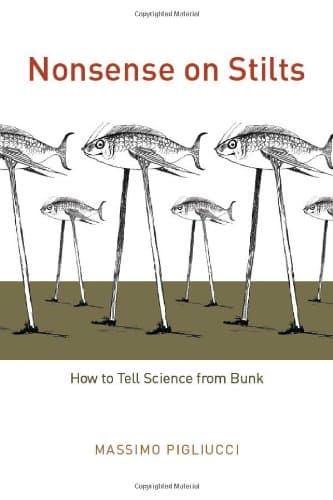
Nonsense on Stilts: How to Tell Science from Bunk
هراء على ركائز متينة: كيفية تمييز العلم عن الخرافة
Absurdités sur Échasses : Comment Distinguer la Science de la Pseudo-Science
Editorial summary
This work examines the demarcation between genuine science and pseudoscience, offering tools for distinguishing empirically grounded knowledge from unfounded claims. Pigliucci, a philosopher of science with a background in evolutionary biology, develops a systematic approach to evaluating controversial claims across various domains, including those touching on religious and metaphysical questions.
The monograph addresses the God debate indirectly through its analysis of how scientific methodology intersects with supernatural claims. Pigliucci argues that many purportedly scientific arguments for divine intervention or design fail to meet basic criteria for scientific inquiry, lacking testability, falsifiability, and predictive power. He examines intelligent design theory as a paradigmatic case of pseudoscience masquerading as legitimate scientific discourse, demonstrating how it violates fundamental principles of scientific reasoning while attempting to appropriate scientific language and institutional structures.
Central to Pigliucci's argument is the distinction between methodological and philosophical naturalism. He contends that science operates under methodological naturalism not as an ideological commitment but as a practical necessity for empirical investigation. This framework, he suggests, neither proves nor disproves God's existence but rather defines the boundaries within which scientific inquiry can meaningfully operate. Religious claims that venture into empirical territory become subject to scientific scrutiny, while purely metaphysical assertions remain outside science's purview.
The work engages critically with both religious fundamentalists who reject established science and New Atheist writers who claim science definitively disproves religious beliefs. Pigliucci advocates for a more nuanced position, acknowledging the limitations of scientific knowledge while defending its reliability within its proper domain. He examines how cognitive biases, social pressures, and institutional failures contribute to the persistence of pseudoscientific beliefs, including those with religious motivations.
Drawing on case studies from creationism, astrology, and alternative medicine, Pigliucci develops practical criteria for evaluating claims that blur the boundaries between science and faith. His analysis provides readers with intellectual tools for navigating contemporary debates where religious and scientific worldviews intersect, emphasizing the importance of understanding what science can and cannot address regarding ultimate questions. The monograph ultimately defends scientific rationality while acknowledging the complexity of demarcating science from non-science in culturally contested areas.
Argument formulations engaged
Related works
Pigliucci, Massimo (2010). Nonsense on Stilts: How to Tell Science from Bunk.
@book{nonsense-on-stilts-how-to-tell-science-f,
  author    = {Pigliucci, Massimo},
  title     = {Nonsense on Stilts: How to Tell Science from Bunk},
  year      = {2010},
  url       = {https://god-database.com/en/works/nonsense-on-stilts-how-to-tell-science-from-bunk-2010}
}