
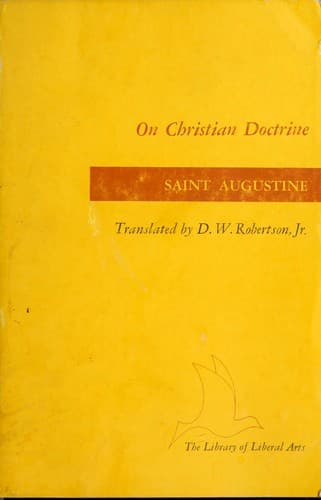
On Christian Doctrine
في التعاليم المسيحية
De la Doctrine Chrétienne
Editorial summary
Augustine's On Christian Doctrine stands as a foundational text in Christian hermeneutics, offering both a theological framework for understanding divine truth and a practical methodology for biblical interpretation. Written between 397 and 426, this work addresses the crucial question of how finite human beings can comprehend and communicate knowledge of the infinite God through scripture and preaching.
The treatise divides into four books, with the first three focusing on the discovery of scriptural meaning and the fourth on its communication. Augustine argues that all truth ultimately derives from God, making the proper interpretation of scripture essential for understanding divine reality. He develops a sophisticated theory of signs, distinguishing between things that exist for themselves and signs that point beyond themselves to other realities. Scripture, in this framework, consists of divinely instituted signs that lead readers toward knowledge of God and proper love of God and neighbor.
Central to Augustine's argument is the principle that scripture must be interpreted through the lens of charity. Any interpretation that does not promote love of God and neighbor fails to grasp the text's divine intention. This hermeneutical principle provides a theological criterion for adjudicating between competing interpretations, grounding textual meaning in God's essential nature as love.
Augustine engages critically with pagan learning, arguing that Christians should appropriate truth wherever found, as all truth belongs to God. This position legitimizes the use of classical rhetoric and philosophy in theological discourse while subordinating them to revealed truth. His integration of Platonic concepts with biblical revelation exemplifies this approach, demonstrating how philosophical categories can illuminate theological understanding without compromising scriptural authority.
The work's enduring significance lies in its systematic treatment of the relationship between divine revelation and human understanding. Augustine provides a theological epistemology that explains how God accommodates infinite truth to finite human capacities through scripture. His emphasis on the necessity of divine illumination for proper understanding challenges purely rational approaches to the God question, while his sophisticated engagement with classical learning demonstrates that faith need not oppose reason.
On Christian Doctrine thus contributes to the God debate by articulating a distinctly Christian epistemology that grounds all knowledge in divine revelation while providing practical methods for accessing that revelation through textual interpretation.
Argument formulations engaged
Related works
Hippo, Augustine of (397). On Christian Doctrine.
@book{on-christian-doctrine-397,
  author    = {Hippo, Augustine of},
  title     = {On Christian Doctrine},
  year      = {397},
  url       = {https://god-database.com/en/works/on-christian-doctrine-397}
}