
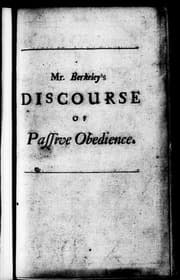
Passive Obedience
الطاعة السلبية
Obéissance passive
Editorial summary
Berkeley's "Passive Obedience" presents a theological defense of political authority that grounds obedience to civil government in divine command theory. Writing in 1712 amid intense debates over succession and resistance theory, Berkeley develops a systematic argument against the right of rebellion that would prove influential for conservative political theology throughout the 18th century.
The work begins from the premise that God's will constitutes the sole foundation of moral obligation. Berkeley argues that human reason can discern certain universal laws of nature that reflect divine intentions for social order. Chief among these is the principle of passive obedience—the duty to submit to established authority without active resistance, even when that authority acts unjustly. This obligation derives not from any social contract or prudential calculation, but from God's direct command as revealed through both scripture and natural reason.
Berkeley's method combines rationalist natural law theory with Anglican theological commitments. He constructs a series of logical demonstrations showing that civil society requires absolute submission to prevent anarchic dissolution. Any exception to the principle of obedience, he contends, would undermine the entire structure of political authority that God has ordained for human flourishing. The argument directly challenges Lockean theories of legitimate resistance and Whig justifications for the Glorious Revolution of 1688.
The theological dimension proves crucial to Berkeley's case. He maintains that suffering under unjust rule serves a providential purpose, testing faith and building virtue. Christians must trust that God will ultimately vindicate the righteous, either through divine intervention or eternal reward. This position aligns Berkeley with High Church Anglican theology against both Catholic theories of papal supremacy over temporal rulers and Protestant arguments for conscientious disobedience.
The work's significance extends beyond its immediate political context. Berkeley's integration of epistemological, theological, and political arguments demonstrates how conceptions of God shape theories of legitimate authority. His insistence that divine command provides the only secure foundation for moral and political obligation anticipates later debates about the relationship between religious belief and civic duty. While Berkeley's extreme position on passive obedience found few defenders after the 18th century, his broader claim that political philosophy requires theological grounding continues to resonate in contemporary discussions about the sources of political legitimacy and the role of religious reasoning in public life.
Argument formulations engaged
Related works
Berkeley, George (1712). Passive Obedience.
@book{passive-obedience-1712,
  author    = {Berkeley, George},
  title     = {Passive Obedience},
  year      = {1712},
  url       = {https://god-database.com/en/works/passive-obedience-1712}
}