
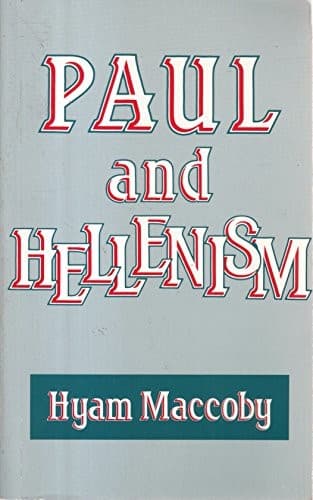
Paul and Hellenism
بولس والهلينية
Paul et l'hellénisme
Editorial summary
This monograph examines the relationship between Paul of Tarsus and Hellenistic thought, arguing that Paul fundamentally transformed Jesus's Jewish message through Greek philosophical and religious concepts. Maccoby contends that Paul, rather than being a faithful transmitter of Jesus's teachings, created a new religion by synthesizing Jewish messianism with Hellenistic mystery religions and Gnostic ideas. The work challenges traditional Christian understandings of Pauline theology as a natural development of Jesus's mission.
Maccoby analyzes Paul's writings through comparative religious methodology, identifying parallels between Pauline Christianity and contemporary Greek mystery cults, particularly those of Attis, Osiris, and Mithras. He argues that Paul's central theological innovations—the cosmic Christ, salvation through faith rather than law, and the mystical union with the divine through baptism and communion—derive from Hellenistic rather than Jewish sources. The author examines how Paul's concept of a dying and rising god who offers personal salvation to initiates mirrors the soteriological schemes of mystery religions rather than Jewish messianic expectations.
The work situates Paul within the religious syncretism of the first-century Mediterranean world, arguing that his genius lay in creating a hybrid religion that could appeal to Gentiles while maintaining superficial connections to Jewish scripture. Maccoby demonstrates how Paul reinterpreted Hebrew Bible passages through allegorical methods borrowed from Greek philosophy, transforming Jewish particularism into a universal salvation myth. This analysis extends to Paul's anthropology, where the author identifies Platonic and Gnostic influences in Paul's flesh-spirit dualism and his devaluation of the material world.
Maccoby's thesis contributes to debates about the historical Jesus and early Christianity by positing a radical discontinuity between Jesus's Jewish reform movement and Paul's Hellenized religion. This challenges both traditional Christian claims of continuity and scholarly attempts to minimize the Hellenistic elements in Pauline thought. The work's implications for understanding God are significant: if Maccoby is correct, the Christian conception of God as Trinity, the incarnation, and salvation through divine sacrifice represent not developments of Jewish monotheism but importations from pagan theology. His analysis suggests that Western Christianity's understanding of divinity owes as much to Greek philosophy and mystery religions as to biblical revelation, raising fundamental questions about the origins and validity of Christian theological claims.
Argument formulations engaged
Maccoby, Hyam (1991). Paul and Hellenism. Paul F Herring.
@book{paul-and-hellenism-1991,
  author    = {Maccoby, Hyam},
  title     = {Paul and Hellenism},
  year      = {1991},
  publisher = {Paul F Herring},
  url       = {https://god-database.com/en/works/paul-and-hellenism-1991}
}