
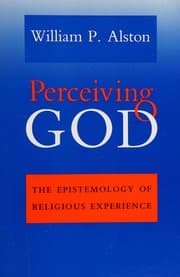
Perceiving God
إدراك الله
Percevoir Dieu
Editorial summary
This monograph advances a sophisticated epistemological defense of theistic belief by arguing that mystical perception of God provides prima facie justification for beliefs about divine reality. Alston develops a comprehensive theory of perception that encompasses both sensory and mystical experience, challenging the widespread philosophical assumption that only sense perception can ground justified beliefs about reality.
The work's central thesis holds that Christian mystical practice, which Alston terms "M-beliefs" (beliefs formed through apparent direct awareness of God), exhibits the same epistemological structure as sense perception. Just as visual experience provides defeasible justification for beliefs about physical objects, mystical experience provides defeasible justification for beliefs about God. Alston meticulously analyzes the phenomenology of religious experience, drawing on both historical accounts from Christian mystics and contemporary reports to demonstrate that subjects regularly form beliefs about God through what they take to be direct experiential encounters.
Against critics who dismiss religious experience as inherently unreliable, Alston argues that mystical perception operates within established doxastic practices that include built-in checks against error and mechanisms for distinguishing genuine from spurious experiences. He contends that the Christian mystical practice has developed over centuries with its own criteria for evaluation, much like scientific observation has developed standards for reliable measurement. The work engages extensively with naturalistic explanations of religious experience, acknowledging their possibility while maintaining that they do not undermine the epistemic value of mystical perception any more than naturalistic explanations of visual processing undermine ordinary perceptual beliefs.
Alston's approach proves particularly innovative in its treatment of religious diversity. Rather than viewing conflicting mystical traditions as mutually undermining, he argues that different religious doxastic practices may apprehend different aspects of divine reality, though he maintains that Christian practice possesses unique epistemic advantages. The monograph's philosophical significance extends beyond religious epistemology, offering insights into the nature of perception, epistemic justification, and the rationality of belief-forming practices generally.
This work fundamentally reshapes debates about religious knowledge by shifting focus from arguments for God's existence to the epistemic status of experiential encounters with the divine. Alston demonstrates that those who report perceiving God may be as epistemically justified in their beliefs as those who trust their sensory experience of the physical world.
Argument formulations engaged
Related works
Alston, William (1991). Perceiving God. Cornell University Press.
@book{perceiving-god-1991,
  author    = {Alston, William},
  title     = {Perceiving God},
  year      = {1991},
  publisher = {Cornell University Press},
  url       = {https://god-database.com/en/works/perceiving-god-1991}
}