
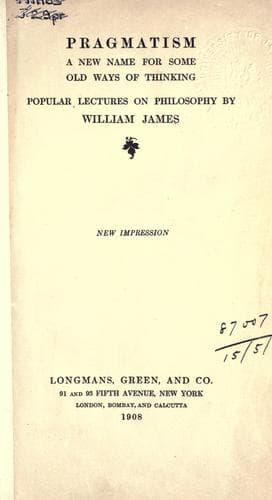
Pragmatism: A New Name for Some Old Ways of Thinking
البراغماتية: اسم جديد لبعض الطرق القديمة في التفكير
Pragmatisme : Un nouveau nom pour quelques anciennes façons de penser
Editorial summary
William James's Pragmatism: A New Name for Some Old Ways of Thinking presents a revolutionary philosophical method that profoundly reshapes debates about religious belief and the existence of God. Rather than engaging in traditional metaphysical arguments about God's existence, James develops pragmatism as a mediating philosophy that evaluates beliefs, including religious ones, by their practical consequences and lived effects rather than their correspondence to abstract truth.
The work emerges from James's 1906 Lowell Lectures, positioning itself between what he characterizes as the tender-minded rationalist tradition and the tough-minded empiricist approach. James argues that pragmatism offers a third way, one that respects both the human need for religious consolation and the demand for empirical rigor. His central thesis holds that the truth of any belief, including belief in God, should be measured by its practical effects in human experience rather than by metaphysical proofs or logical demonstrations.
James's treatment of religious questions occupies a significant portion of the work, particularly in his lectures on "The One and the Many" and "Pragmatism and Religion." He contends that the pragmatic method dissolves many traditional philosophical disputes about God by showing them to be meaningless when they make no practical difference. However, where religious beliefs do make a difference in human conduct and experience, pragmatism takes them seriously as potentially true. This approach allows James to defend the legitimacy of religious belief without requiring traditional theological or philosophical foundations.
The work's contribution to philosophy of religion proves transformative. James argues that if belief in God produces beneficial effects in believers' lives, provides moral energy, and enables human flourishing, then pragmatism validates such belief as true in the only sense that matters. This position challenges both dogmatic atheism and traditional natural theology, offering instead a functional understanding of religious truth.
James's pragmatic method influences subsequent discussions about religious language, the verification of religious claims, and the relationship between faith and empirical evidence. By shifting focus from metaphysical speculation to experiential consequences, the work opens new avenues for understanding religious belief as a legitimate human response to existence. His approach anticipates later developments in religious naturalism and process theology while providing philosophical support for religious pluralism and personal faith experiences.
Argument formulations engaged
Related works
James, William (1907). Pragmatism: A New Name for Some Old Ways of Thinking. Longmans, Green & Co..
@book{pragmatism-a-new-name-for-some-old-ways-,
  author    = {James, William},
  title     = {Pragmatism: A New Name for Some Old Ways of Thinking},
  year      = {1907},
  publisher = {Longmans, Green & Co.},
  url       = {https://god-database.com/en/works/pragmatism-a-new-name-for-some-old-ways-of-thinking-1907}
}